





Listening
Contents
The first thing we notice is how phase coherent the ATCs are; there is an impressive consistency in the timing of the sound waves that travel from the two drivers to the listener. This makes it sound, we have no other word for it, credible. And after listening for a while, changing tracks, sources and cables, this impression is confirmed. We hear every change and not just that it sounds different, but also why and what causes it. And that makes listening to the SCM20A fascinating and addictive. Because it is as if these monitors allow us to truly hear how the recording should sound according to the musicians, the audio technicians and the conductor in the studio’s control room.

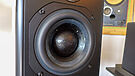
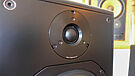
For example: Mooie Dag by Bløf is on our list of test tracks because it is a very spacious recording. Mastered in Wisseloord by Sander van der Heijden, we once listened to this recording with Sander in this studio. So we know how it should and can sound. The special thing is that the spatial effect on the ATCs is much more precise than we are used to. On the Tannoys, to name another extreme, the rhythm guitar surrounds us at 0:21, like a kind of 3D soundscape. The same thing happens with the different guitar and synthesiser effects in this song. The SCM20A also has this spatial effect, but it is much more controlled.
Jacques
Even when we play Jacques Loussier (Little Fugue, you know) we don’t hear the enormous oomph of the kick drum, the beat on the tom that disappears metres behind us or the piano keyboard that takes on wall-to-wall dimensions. It is exactly as it should be: a jazz trio syncopating a jazz fugue. And, not unimportantly, we don’t miss the sub-bass. It is often said that a subwoofer should be added to this monitor, but we do not share that opinion. There is enough bass to assess the track from a short distance. For the full bass, we can turn to the larger monitors in the studio.
Seeing with your ears
Let’s play classical music, Mendelssohn’s 4th symphony conducted by Lorin Maazel, recorded in 1961 (Deutsche Grammophon). We never cease to be amazed at how well the ‘Toningenieure’ of DG have produced classical recordings from the 50s and 60s. This recording is bursting with energy and it is bizarre how layered and energetic the orchestra sounds. The acoustics of the hall are simply tangible. My colleague Martijn can distinguish the mouthpieces of the flutes on this recording. I had the idea that I could see the shoe size of the cellist in the second row on the right (just bluffin’).
Then a music track taken from YouTube accidentally came through the speakers. The compression was so clearly audible and almost tangible that it was eerie and unbearable. Horrendous. On with the rest of the programme.
James
There is something about James Taylor; he always sounds good on ATC. We have experienced this before during a live stream with a big brother (or sister) of the SCM20A. The texture of his voice matches perfectly. It probably has something to do with the midrange, where James Taylor’s voice nestles in wonderfully.
It’s the midrange, once more

The midrange is the essence of a good mix. If the midrange is not properly worked out in the mix (per track, in the master), the final result will be a poor sounding master. And because there are unfortunately more mediocre than good mixes available, not to mention the remasters, the characteristics of most speakers have also changed. These compensate for the midrange by accentuating the bass and treble.
Why is the midrange so important? The answer to this question would be worth a separate article, but the short version is that we are evolutionarily attuned to the human voice in a frequency range of 500 to 2,000 Hz, with the emphasis on 1,000 Hz. This has to do with the fact that parents can distinguish the voice of their own child from that of other children. It is not for nothing that the crossover frequency of the SCM20A is set at 2,100Hz.
Throughout history, this ‘instrument’ has been the most important thing for us to hear, for communication and survival. So although the shape of our outer and inner ear has a lot to do with our hearing propensity, the brain has also been wired to key in on midrange (Paul Abbott, TapeOp).
On these ATCs, working on the midrange is a great pleasure. And listening to it is too. Seal’s album Standards, on which he recorded the classic Sinatra versions of the American Songbook, sounds fantastic. The acoustics of the Capitol Studios are clearly audible, Seal’s voice sounds distinct and layered, and here too we don’t miss the sub-bass for a moment.
Random Access Memories by Daft Punk was released in a ‘Drumless edition’; that’s right, the entire album without the drums. On the SCM20A we hear so much information that was simply inaudible on the original album due to the loud drums. Here we can clearly hear how detailed and perfectly produced the mix is by the robots of Daft Punk.
Hi, just to share my experience with the Atc Scm20 LE (Active) and the Atc C4 mkII subwoofer. I previously had the Atc Scm40A (wonderful speakers, sometimes seemed to overpower my not dedicated room, of 20 square meters but more then 80 cubic meters) and a pair of Harbeth M40.2 Anniversary speakers, in this case I have experienced problems with bass nulls, depending on the bulkiness of the speakers and the few options I had for positioning speakers and listening chair, in a room so dimensioned. Now, choosing a preferable smaller speakers as the Atc Scm20 and the C4 subwoofer, I had the opportunity to experiment with different positioning options, reducing resonances and bass nulls.
Sounds plausible. Big speakers can give issues that smaller ones don’t. Adding a sub to two nice monitors can give a very, very good result!
Hi. I have demoed the ATC 20actives in store and love the clarity etc. I may however miss some bass. I have checked out your ATC C4 mk2 sub out and think this maybe a great addition to the 20s,
My question is at £6500 for the 20s and £4500 for the C4 does that bring in the 50 actives into play. Still a bit to pay also but lose the big sub!
My room is 4.0m x 4.2m in size with normal ceiling height. Will the 50s overpower it🤷
Any experience if the 50s
Regards and thank you for any thoughts.
Hi Yung,
I have been following you guys for some time and I would just like to say, thank you for your work here and sharing your reviews and comparisons. You are just about the only group who actually compares like products in a systematic manner. As a former HiFi dealer, we used to take great care in not only comparing products in the evaluation for what to carry in the store but we went to great lengths to find proper combinations of components etc. It is a sad situation that this is just simply not done for the most part in the majority of the market. Publications, be it in print or on-line nor dealers take the time for the most part. So, thank you for that effort. It takes time and dedicated effort and it is very much appreciated.
I am curious how you would compare the ATC SCM 20A to that of the equivalent monitor in the PSI line? Also, in the ATC passive line up, how would you characterize the differences between the SCM 12 Pro and SCM 20 Pro?
Thanks, again….Best regards….John
Hi John,
Thanks so much for your kind words! We strive to do just as you mention; to be as transparent as possible in sharing what we hear and experience. And yes, to compare it with like products (which is not always what all manufacturers want). Let’s just say that the brands we are reviewing here are confident to be compared with other models, and have confidence in our methods.
On your question: I have only listened to PSI monitors on a factory visit and at PSI/Weiss booths during hifi shows. The PSU A21-M is also a 2-way active speaker, the crossover frequency is at 2.4 kHz. I was really impressed by the larger model, the PSI A25-M. A three-way system, midfield. You should compare therse two if you want a serious shoot out. I would say, based on my memory, that PSI sounds a little more ‘hifi’ than ATC. This is also due to the bass reflex topology of PSI whereas ATC is a closed speaker. The ATC SCM20A is almost twice the weight of the PSI A21-M, which says something about the inertia of the speaker casing. But both brands are a pleasure to listen to. No listening fatigue, very accurate and fast.
On the passive ATC monitors: I have not listened closely to these yet. In general, you will need very good amplification for these speakers and since this has already been done by ATC in the active models, we think the price/quality ratio is in favour of the latter category. Unless you already have very beefy and precise amps, look for the active models.
Yung,
Thanks for the prompt response and your perspective. In these days of pay to play by the manufacturers and distributers, it is a breath of fresh air to read and hear via your YouTube group reviews. You guys are doing a great job and approach things from a clean slate. That is commendable. Thank you, once again.
Best regards….John
ATC SCM 20A Pro. You wrote under Cons:
“Everything is audible
Poorly mixed tracks are mercilessly exposed”
Aren’t those the point for a Pro studio speaker?
Yes, you are right that this is the point to pro monitor speakers.
Nevertheless, you would be surprised how many of these speakers perform differently compared to the ATC SCM20A.
We have reviewed quite some professional monitors, please read these and this review. The list of pros and cons does not cover the full story.
Happy reading!