




Something about ATL - Advanced Transmission Line
Contents
What PMC is all about, of course, is the ATL system: Advanced Transmission Line with the Laminary X flow technology which controls the airflow through this transmission line. PMC has been working on this for more than 30 years.



A transmission line is substantially different from a bass reflex system. A transmission line is basically a long pipe with a bass unit at the end. This ‘tunnel’ attenuates high and mid tones but does allow the lower frequencies to pass through. The area in which this ‘tunnel’ works is much larger than in bass reflex which is often tuned to a single frequency.
However, the proper design of a transmission line is much more complex, expensive and takes up more space (i.e., the cabinet must also be larger). Although the transmission line is designed around a certain frequency, it works much more broadly than a bass reflex system (the attenuation is also never 100%, allowing harmonics to come along as well, which is mostly beneficial for natural reproduction).
However, a tranmission line does stand 90 degrees out of phase. The playback at the rear of the unit is 180 degrees out of phase, the transmission line is usually 1/4 of the wavelength, so 180 90 degrees = 270 degrees, resulting in -90 degrees out of phase.
This is not an immediate problem, because the whole system is thus much more broadband, which means that the energy in the bass contributes longer and more broadband. This compensates for the part around the tuning frequency, which is out of phase. This is in contrast to a bass reflex system where, although the port is ín phase, it cuts off much more abruptly outside the tuning frequency. (This is actually always noticeable and audible, your author thinks. Especially at softer volumes).
Examples – Transmission Line, Bass Reflex, Closed
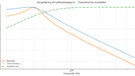
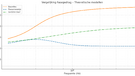
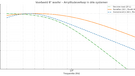
Here are some examples of amplitude and phase progression of a closed system, a bass reflex system and a transmission line. Which is better or more favorable is always up to the manufacturer’s use a design.
-
Theoretical models – amplitude
- Bass reflex (orange) gives a clear peak around tuning.
- Transmission line (blue) runs smoother, with deeper response.
- Closed box (green) falls off nicely by 12 dB/octave.
-
Theoretical models – phase
- Bass reflex: sharp turnaround around tuning.
- Transmission line: around -90°, but spread out wider.
- Closed box: predictable and gradual to -90°.
-
Practical example 8″ woofer
- Closed (20 L): tight, but little output below ±60 Hz.
- Bass reflex (30 L, fb=40 Hz): more punch around 40 Hz, but abruptly tapering off below that.
- Transmission line (60 L, fb≈35 Hz): larger cabinet, but smoother and deeper low end.


You advice to not use the Prophecy1 in too large a room; would you also caution against that when using a sub? Wouldn’t standmounters plus sub in general be able to fill a room with sound just as well as floorstanders without a sub?
Transmission line is all about timing coherency of the bass. I don’t think adding a sub works. That’s why there’s a line of floor standers as well.
Very interesting speaker for me and thank you for a great review!
This is a very specific use-case that you might not have tried… but let me ask anyway since its very important for my own use-case.
Does this one work in a near field setup, where I am only aprox 130cm from the speakers?
I ask since i have auditioned a few speakers on that distance and sometimes the soundstage doesn´t come together that close, i have noticed.
I can see that the distance between the tweeter and the midrange woofer is relatively big, which worries me a bit.
If that actually matters is only my own amateur guesses… 😀
Thanks again for great work for the audio community!
You might want to take a look at the Dynaudio LYD series : https://dynaudio.com/professional-audio/lyd
In case of near field speakers: the pro audio speakers made for this use case are unbeatable. Most of them are active. For good reasons: better control on the phase accuracy, which makes or breaks the soundstage, especially in near field use.
PMC, obviously, has a series of their own for near field use: https://pmc-speakers.com/studio/nearfield/
Thank you so much. Will have a closer look at active studio monitors then instead, and try to audition them.