



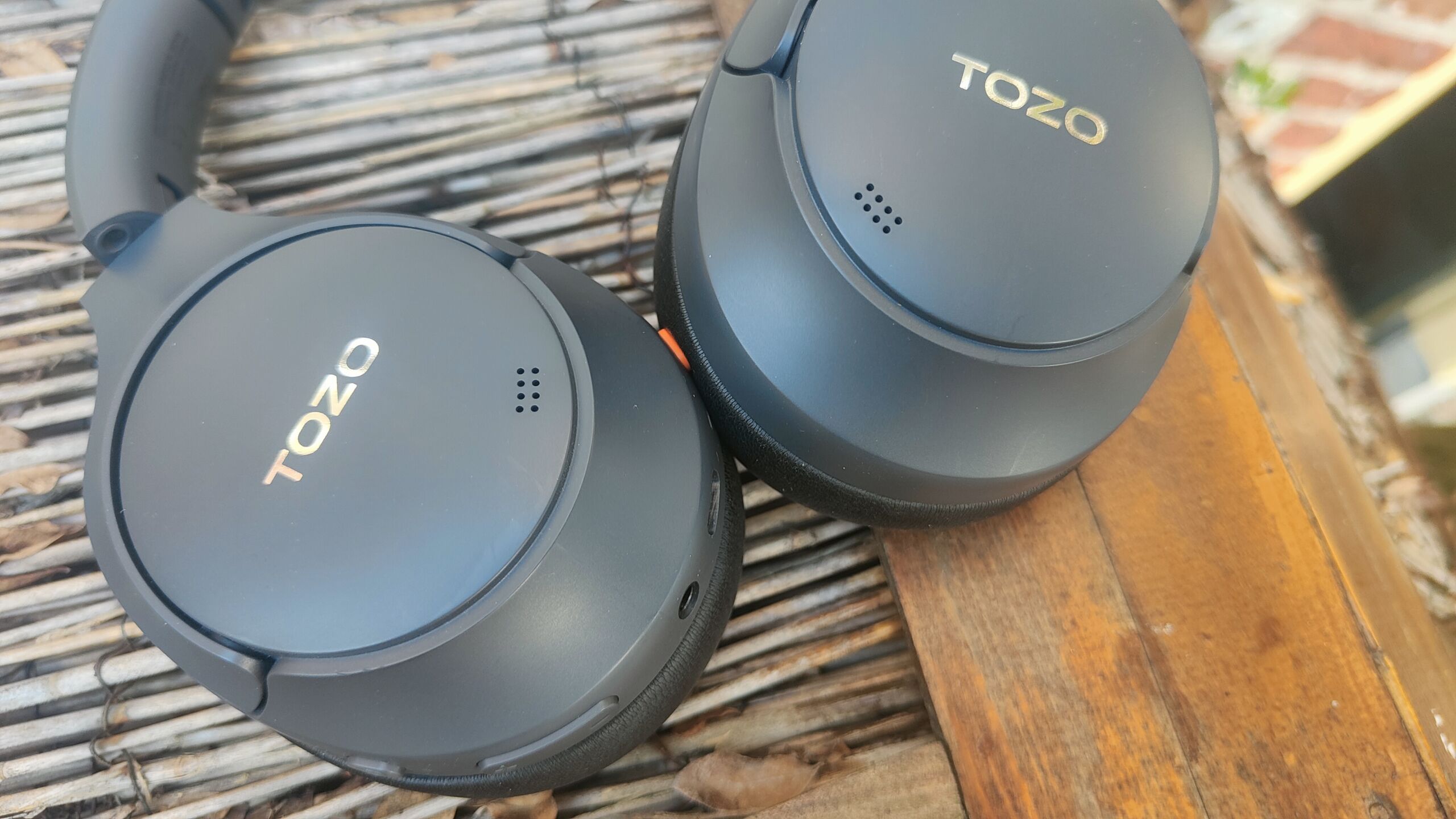
Listening to the TOZO HT3
Contents
The HT3 is bass-heavy, but if you find that too much, you can adjust it by tweaking the EQ in the app. You can also create your own sound profile. For us, the EQ via the TOZO app works better than the EQ settings in a playback app like VOX.


We play “History Repeating” by Stereophonics. Shirley Bassey’s voice comes through nicely and richly, and when the beat kicks in (in the neutral EQ setting), we are treated to a rich and full-bodied track. What is remarkable is that clarity is maintained even at high volume, something that improves further when we turn the bass down slightly.
The HT3 doesn’t pass the Jacques Loussier test, which is hardly surprising. The tricky thing about the “Little Fugue” is that it serves as a benchmark for the accurate reproduction of double bass, drums and piano.
The bass sounds loose and woolly, the drums, and especially the floor tom, are presented far too heavily, and the piano sounds too warm, too big. We don’t expect the target audience for the HT3 to consist of Jacques Loussier devotees, but we are once again reminded just how useful these 2 minutes and 25 seconds are for testing.
Mid
You will all be familiar with Janis Joplin’s “Mercedes Benz”, but the interpretation by an unnamed French a cappella ensemble will only ring a bell for those who own a Focal JM (No. 2) CD. It is a test CD, and this track sits somewhere between a drum track with and without compression and other sound effects such as breaking glass and a tape being wound from left to right.
“Mercedes Benz” is very well recorded without much post-production. A good track for testing the midrange. On the TOZO HT3, it doesn’t sound very well defined. The vocals on “Mercedes Benz” are very close together and difficult to distinguish. The bass is nicely deep, though. The midrange remains a bit in the background.
Highs
The highs are noticeably mild. Even when we set the EQ to maximum, it does not improve. Strange.
After listening for a while, we start to get a feel for when these headphones sound good. With EDM and remasters, which are often heavily compressed, they sound fine. The sound is balanced. When we listen to original versions with plenty of headroom and dynamics, we constantly have to adjust the volume. We haven’t often experienced it being this extreme.
We have taken the HT3 with us on the train and on bike rides over the past few weeks, and it is actually just a very pleasant pair of wireless headphones. They are comfortable to wear (though we reckon people with a large head circumference might find them a bit too tight), we could not drain the battery (kudos to the battery life), and being able to switch between ANC on/off or pass-through via a little orange button is very handy.
The ANC works well, just like the HT2. We have experienced better noise cancellation before, but this is good enough for a busy train or other noisy environment. One minor drawback is that the HT3 doesn’t switch off if it is inactive for a while. On the other hand, the battery is so powerful that we didn’t find this to be a problem during the test period.
Spatial
To test the spatial setting, we watched a few films with plenty of surround effects. Well, the HT3 did not disappoint us. We are treated to powerful sub-bass and the sound is truly cinematic; we are right in the middle of it. Everything is flying and thundering around us!
Conclusion
Whilst the TOZO HT2 is a good hi-fi headphone for us, the HT3 emphasises heavy bass reproduction, making it suitable for fans of electronic music with a lot of compression.
The Spatial function works well, making them a pleasant pair of headphones for watching films too. For those who prefer acoustic music (jazz, folk) or classical music, these headphones are over-tuned. But it’s great that TOZO’s over ear line gives customers something to choose from.