



Listening and use
Contents
The Portazos clearly reveal the difference between sources. At the time of writing this review, we are changing (and hopefully improving) the setup of the headphone test street.


We have a nice CD player as a source, three headphone amplifiers, the Mutec reclocker and have improved the cabling (power, RCA interlinks). The Portazos allowed us to perceive the differences very well.
Soundstage, timbre, tonal balance; it is all clearly audible. As we are used to with planars, the amplifier makes a big difference. With the USB-C dongle, we notice that it (pun intended) lacks punch. The Burson Conductor is a powerful amplifier, tuned on the warm side; the EarMen combination of DAC, amplifier and power supply is a lot more neutral. The Portazos let you hear it well. We also like the fact that the cable transmits very little contact noise. Microphony from a headphone cable is very annoying; more attention should be paid to this.
Soundstage
We expected the music to be more around us due to the planar technology. We have experienced this before with higher-priced balanced armature IEMs.
The Portazos project the sound between the ears, but not outside them. Again, we note that this depends on the eartips you use. Because the “tube” of the in-ear is quite flat and wide, we had difficulty finding well-fitting eartips and were unable to vary them.
Production
We were also able to work well with the Portazos when editing podcasts. Adjusting the desired compression and EQ per audio track worked excellently on these in-ears. I always check a good mix by playing it back on the internal speakers of the Macbook Pro or on a Sonos speaker. If it sounds good there (in the case of podcasts, understandable), it is good.
Comparison
We haven’t really had the opportunity to listen to planar IEMs in detail before. A search reveals that brands such as Campfire and Astell & Kern offer this type, for prices above 1,000 euro, with Astell & Kern at almost 3,000 euro. On the other hand, we see a chi-fi brand like KZ offering a planar IEM for 125 euro. Huge price differences. We may come back to this in more detail in a future review.
Conclusion
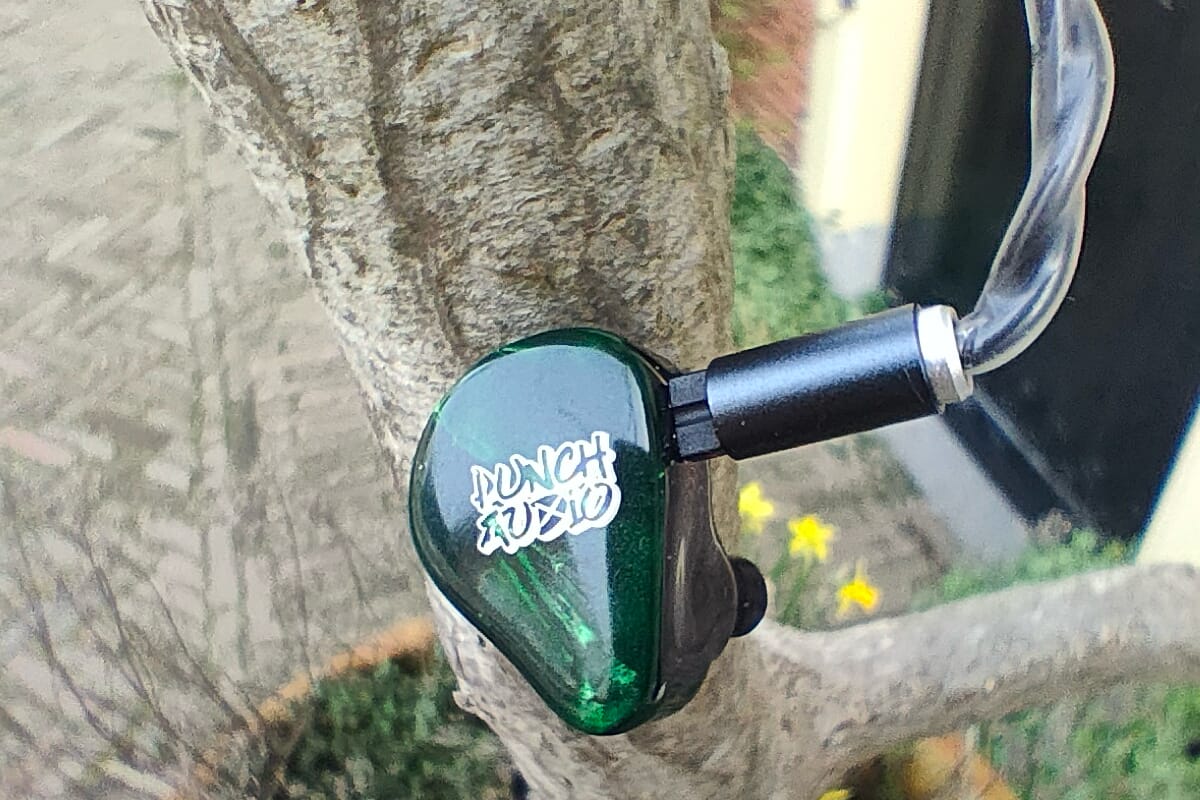
The Punch Audio Portazo is an excellent in-ear monitor at a great price. However, the way this friendly IEM is marketed is a lesson in dealing with disappointment.
Bass lovers will not see the promises of a cool-vibrating sub-bass fulfilled. The rest of the world hears a quality product in the Portazo; a planar IEM that would feel at home in a higher price category in terms of finish, included accessories and performance. Put a different label on it and we are completely happy with the Portazo.
Mooi dat jullie regelmatig IEMs testen. Om een serieus goede IEM te kopen ben ik vorig jaar een aantal modellen gaan luisteren, en het is de Campfire Audio Astrolith geworden. Uitgerust met plane drivers en ruim boven de 2000 euro, maar wat een gebalanceerde sound! Dit moet je echt een keer beluisterd hebben. De Astrolith heeft een wat V shape geluidsbeeld (het mid is iets meer teruggetrokken) goed ruim in de bas en een prachtig hoog. In combinatie met een goede DAP natuurlijk en high res audiofiles, een belevenis.
De FiiO FX17 heb ik ook beluisterd en deze is ook (heel!) erg goed. Toch de Astrolith vond ik fijner om langere tijd in te hebben, draagt prettiger en lichter.
Ik heb enkele ChiFi IEMs beluisterd en getest (merken als KZ), deze waren ruim onder de 100 euro, en niet slecht presterend maar in vergelijking met de toppers van FiiO en Campfire ga je met de ChiFi terug naar Mp3, terwijl ik echt naar Wav luisterde: het geluid wordt platter, je levert in op dynamiek en maakt mij luistermoe binnen 15 minuten. Verder prima IEMs voor podcasts en Youtube filmpjes maar voor muziek schiet het tekort. High End is het echt niet.
Since this is the English section of our platform, I will translate your comment: “It’s great that you regularly test IEMs. To buy a seriously good IEM, I listened to a number of models last year, and I ended up choosing the Campfire Audio Astrolith. Equipped with plane drivers and costing well over £2,000, but what a balanced sound! You really have to listen to this at least once. The Astrolith has a somewhat V-shaped sound (the midrange is slightly more recessed), good bass and beautiful highs. Combined with a good DAP and high-resolution audio files, it’s an experience.
I also listened to the FiiO FX17, which is also (very!) good. Still, I found the Astrolith more comfortable to wear for longer periods of time, as it is lighter and more comfortable to wear.
I listened to and tested a few ChiFi IEMs (brands such as KZ), which were well under £100 and didn’t perform badly, but compared to the top models from FiiO and Campfire, the ChiFi takes you back to MP3, whereas I was really listening to WAV: the sound becomes flatter, you lose dynamics and it makes me tired of listening within 15 minutes. Otherwise, they are fine IEMs for podcasts and YouTube videos, but they fall short for music. They are definitely not high-end.”
I have listened to a number of top models from 64Audio, Campfire and, previously, electrostatic versions from Stax. On stage, I use in-ear monitors from Shure and am perfectly satisfied with some KZ IEM’s. A while ago, I review final B1 and B2. Very interesting IEM’s as well: https://www.alpha-audio.net/review/review-final-audio-b1-and-b3-in-ear-headphones/
These premium brands have MMCX connectors. Chi-fi is, imho, making swift progress in enhancing the sonic achievements of IEM’s. The pricing is rising, but still at affordable levels. I tested Kiwi Ears Orchestra II with 10 BA-drivers, at a price point of 349 EUR. I didn’t do an AB comparison but it approaches the much pricier IEM’s of afore mentioned brands. Also the quality of the cables and connectors is improving. I definitely would qualify this one as high end.