



The test results
Contents
This is a listening test carried out in a single session by a single reviewer. It cannot be compared with the extensive tests we have carried out. I was personally curious about the differences and have written this review based on the comparison. The results may differ in your own system and to your own ears, but I will attempt to explain the differences.
Soundstage
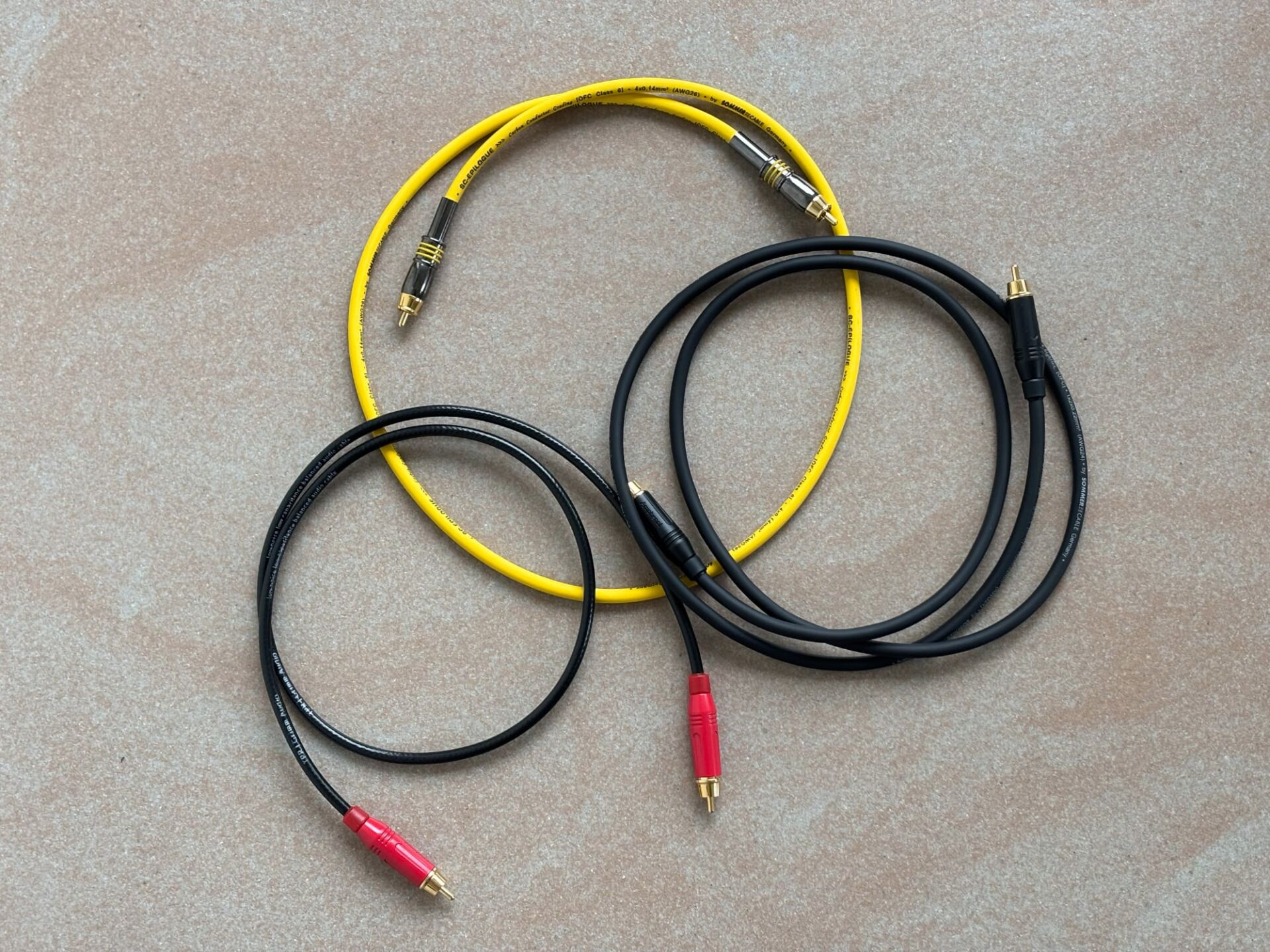
The two Sommer cables are clearly cut from the same cloth. The soundstage is wide with both cables, and the TPR’s soundstage is noticeably narrower. The difference is that the Stage 22’s soundstage is less deep than that of the Epilogue. The TPR has a deep soundstage, comparable to that of the Epilogue.
In Dvořák’s work, the difference between the TPR and the Epilogue is striking. With the TPR, you feel as though you’re sitting in a concert hall and can sense your seating position. The choir is clearly positioned behind the orchestra.
With the Epilogue, you feel less as though you are in the hall and you are much closer to the music.
Across all three tracks, the proportionality in the TPR’s soundstage is the best, whilst both Sommer cables deliver a grand soundstage that is somewhat more detached from what you would expect in reality. Furthermore, the Epilogue is the cable with the greatest layering in the soundstage of the three.
Detail, dynamics and microdynamics
The main difference between the Stage 22 on the one hand and the TPR and Epilogue on the other is the reproduction of dynamics in the music. The Stage 22 clearly lags behind in this respect. The differences in dynamics – the contrast between the quietest and loudest passages – are audibly less pronounced.
The TPR and the Epilogue reveal more detail, particularly in the microdynamics. In David Sylvian’s track, a little bell can be heard towards the end. This is much more clearly defined with the TPR and Epilogue. The sounds produced by Bendik Giske using the saxophone’s keys are much more recognisable as keys being closed with some force.
The Epilogue has the quietest background, making details clearly audible. Nevertheless, the TPR is every bit as good; it is the perception of tranquillity that differs. The TPR sounds much more energetic, whilst the Epilogue is somewhat more restrained.
This is most clearly reflected in the lyrics sung by David Sylvian. With the TPR, there’s a glimmer of hope in the line ‘Let the happiness in’. With the Epilogue, ‘Let the happiness in’ is more of a plea following ‘I am waiting for the agony to stop’.
With the Epilogue, the reverberation is more prominent in Cristina Barbieri’s track. In the saxophone, the emphasis is slightly more on the lower end of the mid-range; it sounds a bit more robust than the TPR, which places more emphasis on the upper end of the mid-range. With the Epilogue, it is a bit more ‘bass-heavy’. The TPR has more swing, whilst the Epilogue is somewhat more restrained rhythmically, which makes the pacing feel different. The Epilogue lends more authority to the sound, whilst the TPR is a bit looser and more energetic.
Listening experience
Both the TPR and the Epilogue are more compelling to listen to, whilst the Stage 22 offers a somewhat more relaxed listening experience. The soundstage is less sharply defined and somewhat more diffuse, but the Stage 22 envelops you more in the music. This is mainly because the midrange of the Stage 22 sounds very transparent and the effort required to follow what’s happening remains minimal. You can listen for hours on end with this cable.
Conclusion
The Chris Cables Core Function (Sommer Stage 22) cable is particularly suitable if you are not looking for the most detailed reproduction and mainly want to listen to music for relaxation. Both the Grimm TPR and the Sommer Epilogue are much more demanding to be listened to, at least if you share the same pleasant neurotic diversity as an Alpha Audio reviewer.
If your entire setup already has a somewhat punchy character, both Sommer cables are a better fit. This is the reason I prefer the Sommer Epilogue for the Rega turntable, where the Ania MC cartridge can sometimes sound a bit harsh in the highs. The Epilogue smooths out the sharp edges there.
The proportionality of the Grimm TPR is nice when you listen a lot to classical music, or jazz music with acoustic instruments.
You will not make a bad purchase with any of these three cables, which once again proves that equipment made for professional use does what it is supposed to do, without gimmicks and without exotic price tags.
Hi,
Thank you for this comparison.
Just to let you know, the Grimm TPR cables have recently been modified. The RCA plugs are now sourced from a different supplier, are shorter and are stamped ‘Grimm’; the small capacitor that used to connect the negative terminal to the shielding braid on one end has disappeared – was this an oversight or a deliberate choice?
If your question is about the connection of the shielding, you should ask the seller. As far as I know, Grimm provides cable and Magna Hifi adds the connectors.