



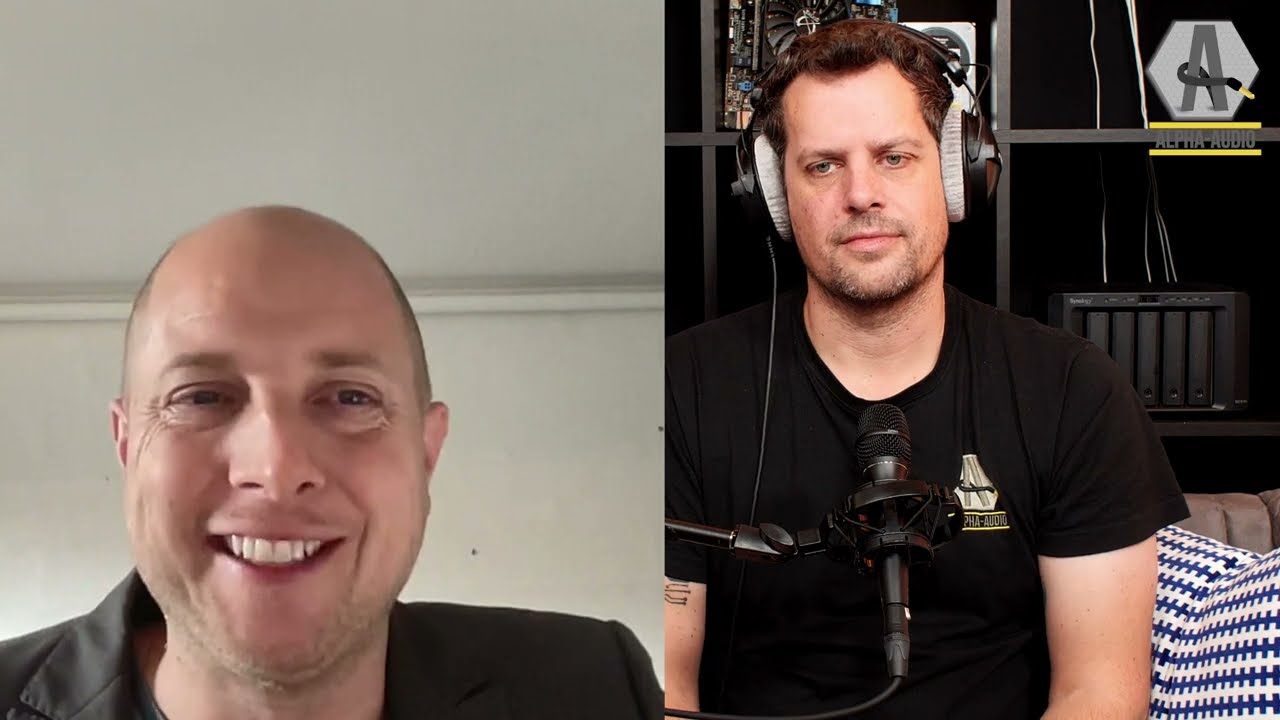
We have another interesting talk with Joakim Juhl; founder and owner of OePhi Cable (Denmark). This time we talk about digital cables. Are there actually digital cables? We are about to find out!
NB: this is a article-version of the transcript of the interview. You can view the interview, or listen to it as well.
Check the Interview
Listen to the interview
Read the article version
A cable is just a cable. Right?
That’s what you often hear. Especially with digital cables: bits are bits, and as long as the checksum matches, it doesn’t matter how you transport them. End of story.
But anyone who truly listens – not five minutes in a shop, but hours in their own room – realizes that there’s more to it. Music can feel calm or restless. Sometimes it just doesn’t sound right. And often the cause isn’t the recording or the speakers, but something far subtler: the time domain.
From hobby to brand
The designer we spoke to started, like so many, as a hobbyist. Cables, amps, speakers – endless tinkering and listening. After a career in research, with an academic background, Covid became the moment to start a brand. With a clear philosophy: combine measurements and listening. Never let theory outweigh what your ears tell you.
And that led him to cables. Because although measuring equipment often shows little difference – frequency response flat, distortion negligible – listeners still hear differences. The secret? Timing.
Time domain: the invisible key
Our hearing is insanely sensitive to timing. Much more than measurements suggest. At the Technical University of Munich, researchers discovered that ordinary people – not trained audiophiles – could detect timing differences down to a few hundred thousandths of a second. That’s below the measurement threshold.
That explains why two cables with identical frequency response can sound completely different. In the time domain, information shifts or gets lost. And once it’s gone, it’s gone. You can smooth a frequency curve, but you can’t pull a misplaced pulse back into line.
Cables that simply sound right
A system that plays correctly in time feels natural. It doesn’t blow you away with fireworks, but it just sounds right. As the designer says: “Many people hear our setup and independently tell us: it simply sounds correct.”
It’s like TVs in a store. Put the colors on neon pink and you’ll grab attention. But at home it becomes unbearable. Audio works the same way. Systems that impress with bloated bass or sparkling highs often fatigue over time. Real quality is subtle. It disappears. Only the music remains.
Trade-offs: you can’t have it all
In engineering, nothing comes for free. Make a loudspeaker perfectly flat in frequency, and you almost always sacrifice time-domain accuracy. Cables are no different. Low capacitance is good for speed, but changes impedance. Extra shielding seems great, but introduces return currents that mess up timing.
The art lies in balance. Don’t chase one magic number, but aim for stability across the entire transmission. Consistency always beats pretty specs.
Digital signals are also analog
Maybe the biggest misconception in hi-fi: digital signals are perfect and therefore immune. Forget it. A digital cable never carries pure ones and zeros, but analog voltage pulses approximating a square wave.
And perfect square waves don’t exist in the real world. Every edge takes time, every transition rounds off. High capacitance makes pulses slower and rounder, storing energy and releasing it later as ringing. The result: jitter. And jitter strikes exactly where our ears are most sensitive: timing.
Capacitance: the big culprit
Measurements show it clearly: the higher the capacitance of a cable, the greater the spread in propagation speed. In plain words: more capacitance, sloppier timing. Listening confirms it: low-capacitance cables sound tighter, calmer, more natural.
Think of a cable as a tube full of mini-capacitors. Every pulse has to charge them before moving on. More capacitance means slower, rounder pulses. And the further you drift from the ideal square wave.
Impedance and reflections
Impedance matters too. A mismatch between source, cable, and receiver causes reflections: echoes of the signal bouncing back and blending with the original pulse. The result: timing uncertainty.
But – and this is key – it’s not about clinging to a dogmatic 50Ω or 75Ω. What really matters is consistency. Variations from connectors, bends, or poor soldering are far worse than a small deviation in the nominal value.
Computers, jitter, and noise
The importance of timing goes beyond cables. In an experiment with three computers – Raspberry Pi, Intel NUC, and a mini-PC – the same software produced digital data that was bit-perfect identical. Yet the sound was completely different. More or less calmness, timing, bass definition.
How? Because computers are never noise-free. Every processor, power supply, and controller adds disturbances. And audio rarely gets priority in an operating system. The result: timing differences we hear instantly, even when the checksum says all is fine.
Transparency over sugarcoating
The market is full of gear that hides flaws. Warmer voicing, a sweetened balance, always pleasant. It sells. But truly transparent systems don’t do that. They also expose the flaws of a recording. Live tapes from the ’70s, full of hiss and mistakes, can sound merciless. But at the same time, you hear the energy and authenticity.
That’s the philosophy: better raw truth than a polished lie. Not for the masses, but for those who really want to hear music.
Design details that matter
Designing a cable is more than copper and insulation. Geometry, return path, shielding – everything matters. A classic coax design shields well, but lets return currents flow uncontrolled. Better is a geometry where signal and return are tightly guided together.
Even mechanical factors matter: how tight the connector sits, how the soldering is done, how the cable bends. Every detail shapes the wave racing through the line.
Finding the balance
One warning though: don’t overdo it. Pair an ultra-transparent cable with a mediocre source and you’ll expose every weakness. Sometimes a balanced mid-level solution is more musically satisfying.
Audio is always a chain. The cable is one link, but the source, amplifier, speakers, and room matter just as much. The puzzle has to fit as a whole.
Six lessons for listeners
1. Trust your ears. Theory should never outweigh what you hear.
2. Timing is critical. Micro-delays are audible, often below the measurement threshold.
3. Avoid capacitance. Low capacitance means faster, cleaner pulse transmission.
4. Consistency over numbers. Stable behavior beats a pretty impedance spec.
5. Look at the whole system. Computers, power, environment, and noise all count.
6. Transparency wins. Systems that simply sound “right” give lasting joy.
Conclusion
Digital cables are not neutral pipes where bits march through untouched. In practice they are analog transmission lines, full of small delays, capacitive effects, and reflections. And that’s exactly what our ears pick up on.
A well-designed digital cable minimizes these time-domain distortions. The result isn’t fireworks or flashy tricks, but music that flows naturally. Music you can listen to for hours without fatigue.
And in the end, that’s what it’s all about: forgetting the chain of electronics in between, and simply disappearing into the music.
May I please any links or more information about the listening test in TUM which is referred to.
Unfortunately, what this article fails to mention anything about is the fact that the data stream is managed exclusively by the DAC and not the cable.
A modern DAC with a well-designed PLL USB interface or master-clock stage will be immune to jitter. Any jitter/timing variation is corrected or rejected by the receiving chip in the DAC via a FIFO buffer and then asynchronously re-clocked if necessary.
To suggest that a digital cable can influence the resultant audible ‘sound’ is a complete nonsense.
It either performs its’ function as a signal carrier within the AES specification, or it doesn’t.
Older DACs are sometimes incapable of handling jitter if sent via a badly made or out-of-spec cable and will rely on the source clock and this will manifest in a clearly audible stuttering effect. It will have no influence on the ‘sound’ (tone/timbre/timing).
I completely agree that time-domain differences influence the resultant sound and character of anologue cables, my own research confirms that. But it would be more credible if you could offer a tangible, verifiable link between the claim of digital cables have any audible variances for sound characteristics in place of simply proposing a highly-subjective conclusion.
“A modern DAC with a well-designed PLL USB interface or master-clock stage will be immune to jitter.”
I’d like to see the proof of that, because my ears tell me something else.
You’re assuming you actually HAVE audible jitter in the data stream. How can you verify this?
‘Trust in your ears’ is a very easy suggestion to make but this has more to do with subjective listening and relying on a placebo effect.
I suggest conducting a double-blind test to verify if there are any audible differences, or not. But I suspect this idea will be rejected out of hand.
As you know, we have conducted many comparative tests and much of the measurement experiments that Jaap has conducted are published. Even better, people with knowledge have given feedback to adjust the methods of measuring and all of the steps over time can still be read on this website.
I haven’t spoken to any manufacturer who claims that they are absolutely immune to whatever can influence the digital to analogue conversion.
Furthermore, there’s not jitter in a component, jitter (in audio) is a compounded effect of time domain shifts in the signal that trip the digital to analogue conversion and has audible (and by Jaap proven measurable) effects in the sound wave that hits our ears.
https://www.alpha-audio.net/background/on-listening-tests-double-blind-or-not/
It is up to you to design any test and deliver the proof you are correct in what you state. Anyone can exclaim ‘double blind, or it is not true’. As long there is no proof, your assertion is as much an opinion as my claim I can hear differences.
Your posit it is all in my head is technically correct, because my brain processes the air pressure variations that my ears pick up, but your interpretation of the correctness of that processing is just another unproven opinion as well. The anecdotical evidence though can be verified by rewatching a few of the livestreams where I was the crash test dummy.
Unfortunately, conducting outwardly-looking objective tests and measurements and ultimately concluding with subjective opinion does not qualify as proof of anything.
The best test for any audible difference between any component/cable remains the double-blind test, correctly implemented and managed. If you’re really honest to yourself then you will appreciate the value of this test, especially if you want to verify any sort of value-proposition.
I’m not claiming that the placebo effect is not important, becasue it very much is if you believe in it. I declare that opinion to my customers everytime they ask me how much ‘burn-in’ time is required. I.e. it’s not a physical/electrical/material change within the cable, it’s more about psychology and how your brain adapts and familiarises to any changes that are perceived. If it ultimately contributes to the enjoyment of listening to music then placebo is actually critically important.
But let’s get back on topic, as the placebo effect is the only influence that can be applied to digital interlinks when claiming any audible differences, nothing more.
Claiming audible differences between digital interlinks perpetuates those myths and feeds into the snake-oil claims that some manufacturers use to justify ridiculous prices.
EDIT: I should probably add at this point, seeing as you mention that you have consulted people ‘with knowledge’ etc., that part of my own background in aerospace and nuclear engineering was for signal -transmission within mission-critical systems – avionics, flight surface mechatronics, mechanical-handling etc. where precise calculations and engineering for the effects of digital signal transmission were of critical importance in determining overall failure/success for any given system.
😉
Are you manufacturing digital cables? Asking due to your nic here.
I offer a single 110Ohm AES cable model and a single 75Ohm Coax cable model, both using AES-spec components and both sensibly-priced. i.e. not in the 1000’s.
May i ask what exactly you are using as the digital source when you listen/comparing the impact of those digital cables yourself?
I use multiple sources and various measuring tools, including a function-generator and oscilloscope and various analysis software for various voltages/frequencies to confirm/verify AES specifications of the cable types, as well as CD players, streamers, PC etc.
Right, but which CD players and streamers, and how is the streamer connected to power and network?
I ask this because i see a catch-22 when people are septic about digital cables. Then they also feed the cables with dirty signals (since it doesn´t matter anyway, according to that logic) and hence it also doesn´t matter much, or at all.
I appreciate Juhl’s informative discussion of the considerations that go into making a good digital cable. It makes a good reference for those annoying “0’s and 1’s” posts that frequently creep up on forums.
That said, I wonder what evidence he has that “transparency wins” for a “simply disappearing into the music” experience. There are a wide variety of audiophile ears out there, with plenty which don’t find that disappearing experience without a touch of warmth and, contrarily, find the results of a transparency-dominant approach somewhere between not involving — listening to the sound instead of the music — to seriously off-putting (“I’d like to throw the system out the window!”). Juhl’s dismissal of those of us who don’t share his priority strikes me as a prejudice, nothing more than using his personal preference to declare what’s right for all.
It also fails to take into account that artists often choose instruments for having element(s) of warmth in their materials, and some artists prefer an element of warmth in their recordings. I’ve yet to come across a transparent-dominant cable that could handle the latter (the AI programmed cable that can go with the flow has yet to be developed). I do appreciate Juhl’s forthrightness, however, because when considering possible cable and component choices it’s helpful to know exactly what the developer has in mind.
Transparent means no coloration or damage to timing, rhythm… etc.
If the artist records with a touch of warmth, that warmth will be there. If the instuments have that warmth and the recording captured that: it will be there… If it is not on the recording… it will not be there. That’s the definition of transparency.