




JBL has unveiled what it calls the groundbreaking Summit loudspeaker series. At present, the range consists of three models.
According to the manufacturer, the JBL Summit Series may well be the most prestigious loudspeaker concept JBL has ever created:
“A project that effectively began back in 1985 with the introduction of the legendary DD55000 Everest. Then limited to a single model, it has now evolved into a complete family that reflects nearly 80 years of engineering expertise in three masterful loudspeakers. Truly the peak of loudspeaker performance.”
For the quick reader
With its new Summit Series, JBL returns to its roots as a manufacturer of ultimate loudspeakers. The line-up consists of three models: one stand-mount monitor, the Ama (€17,498 per pair), and two floorstanders, the Pumori (€30,998 per pair) and the Makalu (€43,998 per pair). Building on the legendary Project Everest and K2 heritage, JBL promises an unprecedented level of realism.
“Truly revolutionary”
“Of course, as an importer we are enthusiastic about our products, but what the Summit Series – and especially the flagship Makalu – has triggered here has far exceeded our expectations,” says importer Reference Sounds.
They continue: “We dare to say it outright: the performance of the Summit Series is truly revolutionary and offers qualities that leave even the established ultra-high-end market behind. That’s a bold statement, especially as we realise not everyone immediately associates JBL with this level of performance.
This perception is largely the result of the much stronger marketing focus on JBL’s lifestyle segment and the limited European visibility of JBL Premium, rather than a reflection of JBL’s actual product capabilities. Just search for ‘JBL DD67000 Everest review’ on Google and read what the world wrote about JBL’s previous flagship. The Summit Series is therefore not some exotic offshoot from a loudspeaker designer’s imagination; it is the accumulation of years of research, development and faith in compression-driver horn technology. The result may well be the most live-sounding, most realistic, true ‘you-are-there’ loudspeaker experience available. Simply sensational.”
JBL Summit Series – technology explained
Reference Sounds goes into greater depth regarding the technology behind the Summit Series loudspeakers. The text below largely follows the importer’s original wording, including the occasional value judgement:
“The Summit Series consists of three models. From small to large, these are the Ama, Pumori and Makalu. While differing in size, all three share a common philosophy: each is built entirely around in-house developed drivers. At the core of the design is the unique compression driver combined with a strikingly shaped High Definition Imaging (HDI) horn, which forms the foundation and guiding principle for the rest of the design.
This extremely wide-bandwidth tweeter, thanks to its compression-chamber design with dual diaphragms, achieves exceptionally high efficiency. Simply put, with an input signal of just 1 watt, the tweeter produces a sound pressure level at least ten times higher than that of a typical dome tweeter. Conversely, this JBL technology requires roughly ten times less power to achieve the same SPL. The result is extremely low distortion and the ability to convert the input signal into sound with extraordinary precision.
The attached HDI horn plays a crucial role. It provides a more efficient match between the acoustic impedance of the small sound source (the compression driver) and the surrounding air (the horn mouth), while also ensuring controlled dispersion. The horn’s distinctive shape is the result of years of JBL research. The compression-driver horn concept marked the very beginning of JBL and high-quality sound reproduction some 80 years ago, when James Bullough Lansing developed the first cinema loudspeaker.
Like any technology, horn loading also has its challenges: inconsistent directivity, resonances along the horn throat, and decreasing efficiency at higher frequencies. Advances in measurement technology, finite element analysis and insights into the relationship between room acoustics and loudspeaker dispersion have physically shaped a new generation of JBL High Definition horn configurations.
JBL Summit Series – Pumori
The futuristic appearance is not the result of marketing or a fondness for sci-fi aesthetics, but the direct outcome of JBL’s research aimed at overcoming the technical drawbacks of traditional horns. The HDI horn is not moulded from thin plastic, but constructed from a specially developed, low-resonance Sonoglass material. Thanks to its high mass and rigidity, it adds no sonic character of its own and keeps reproduction extremely neutral.
A compression-driver horn assembly from the Summit Series measures approximately 25 × 20 × 20 cm and, according to the importer, weighs at least 3 kg – hardly comparable to an average tweeter, however exotic.
Paired with the D2815K 1.5-inch (38 mm) driver in the Ama and Pumori, and the larger D2830K 3-inch (75 mm) driver in the Makalu, the Summit Series presents every detail with sublime agility, speed and expression reminiscent of electrostatic speakers. At the same time, it delivers an unprecedented sense of realism and a powerful ‘you-are-there’ live experience that is rarely encountered. The wide-band tweeter integrates seamlessly with the mid-bass and, when properly positioned, is capable of creating a truly three-dimensional soundstage.
These are extraordinarily versatile loudspeakers: from delicate, highly detailed and authentic, to raw and dynamic with tremendous impact. Choose the music, and the Summits show you – or rather let you hear – the pinnacle. Large-scale orchestral works by Tchaikovsky with full scale and lifelike tonality, or the expansive electronic soundscapes of Data Rebel, as if strolling through a valley of drifting dandelion seeds on a warm summer evening. They tickle but never sting; they are everywhere without being aggressive. In our view, the way JBL has voiced the Summits – how they can growl impressively yet never bite – is truly sensational.
JBL Summit Series – Makalu
As with the tweeter, the low-frequency driver is also a unique piece of engineering. Fully developed at JBL’s Engineering Center of Excellence in Northridge, USA, every aspect of this in-house design is aimed at extending the energetic and extremely fast character of the high frequencies down into the lowest octaves.
JBL’s starting point for woofer development, just like with the tweeter, is the minimisation of distortion. The key challenges are electromagnetic non-linearities in the motor structure, mechanical distortion that increases with cone excursion, and distortion of the cone itself – all of which influence each other.
Magnet
JBL addresses these issues by designing a perfectly symmetrical magnet structure with very high field strength around the voice coil. The 8-inch and 10-inch woofers in the Ama and Pumori use oversized ferrite ring magnets, while the formidable 12-inch woofer in the Makalu is built around neodymium. In all cases, the magnetic system is optimised to create a high, concentrated field exactly where it is needed. And that is in the gap where the voice coil moves.
Special measures minimise voice-coil inductance to prevent distortion and rising impedance at higher frequencies. The pole piece features a large, streamlined vent to allow pressure and heat behind the dust cap to escape, lowering voice-coil temperature and increasing thermal power handling.

Voice coil
The voice coil operates within a permanent magnetic field. As current flows through it, the coil is pulled inward or pushed outward. The force the magnetic field can exert on the moving voice coil is directly related to the distortion produced by the woofer.
As volume increases, more current flows through the voice coil. That causes it to move further in and out of the magnetic field. At higher excursions, more coil windings leave the magnetic gap, reducing control over cone motion and increasing distortion. JBL combats this by optimising the magnetic field and using an exceptionally long voice coil. Even at extreme excursions, sufficient windings remain within the magnetic field. Resulting in superb control even in the most demanding passages.
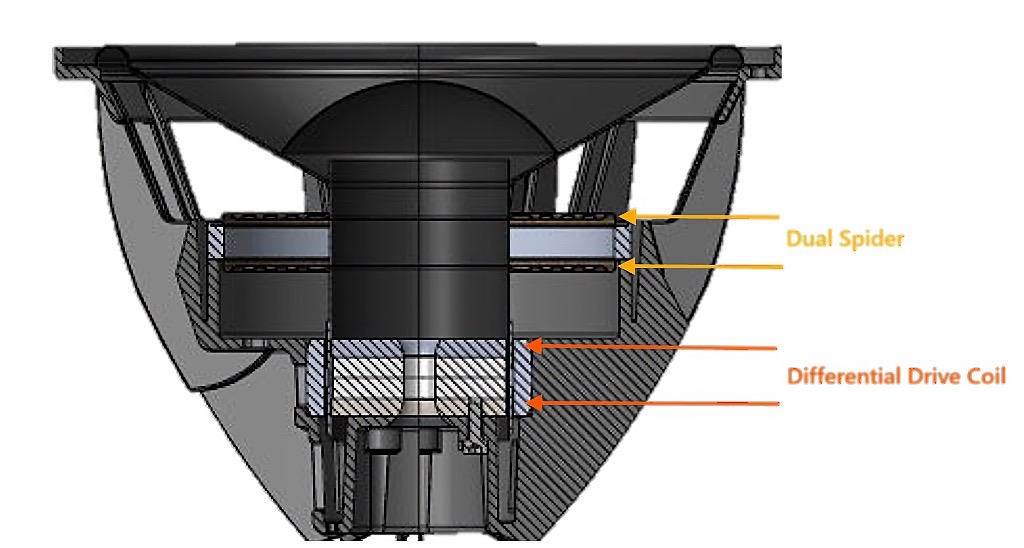
The 12-inch woofer in the Makalu goes a step further with a dual differential drive configuration. This JBL innovation splits the voice coil into two elements. Each operates in its own optimised magnetic field, wound in opposite directions. The result is a lighter coil with lower inductance, reduced heat build-up and greater linear cone motion. Even when one coil section leaves the magnetic field during large excursions, the other remains fully active. That ensures precise tracking of the musical signal even at low listening levels.
Cone
The cone converts the motion of the voice coil into audible sound. Ideally, it must be extremely stiff to accurately follow the drive from the centre, yet lightweight to allow efficient movement. Those are conflicting requirements that force compromises in most woofers.
JBL avoids the easy path and developed an entirely new cone based on a three-layer hybrid sandwich construction. The front and rear layers consist of Carbon Cellulose Composite (C4), a proprietary blend of paper pulp reinforced with carbon fibres for exceptional stiffness. Between these layers is a closed-cell foam core that damps resonances while keeping mass low. The voice coil is centred by not one but two spider assemblies with opposing compression. This ensures superior centring and further reducing non-linear cone motion.
Midrange
While the Ama is a two-way design, the larger Pumori and Makalu are three-way loudspeakers, with an 8-inch midrange driver handling the critical midband. This allows the woofers to focus on the lowest frequencies and further refines mid-bass reproduction. The midrange driver uses a coated textile surround with an accordion profile. It makes the cone stiffer and less suited to large excursions. Which is an advantage in this application, resulting in higher efficiency and power handling.
Crossover
All drivers are integrated via an internal crossover network built around multiple parallel capacitors. This multi-cap technology reduces losses, increases accuracy and improves power handling. The high-order crossover minimises out-of-band distortion by operating each driver strictly within its optimal range. Once again, JBL leaves no stone unturned in its effort to keep the Summit Series free from distortion and to provide a completely neutral window onto reality.
In summary
The Summit Series is truly spectacular, both in terms of technical innovation and sound quality. The large HDI horn dictates the bold shape of the loudspeakers, making them anything but subtle or understated. These are substantial designs that demand attention. At the same time, the finish and choice of materials are of an exceptionally high level. After all, you wouldn’t cram Pink Floyd or the entire Vienna Philharmonic into a tin can.
If you want to experience artists truly live in your own home, you have to give them space. Properly set up, the JBL Summits do this like few others. Without question, the pinnacle of loudspeaker performance – and finally available’.