



The term AI (Artificial Intelligence) is increasingly used in the audio world—sometimes rather liberally. But should you actually be concerned about it?
Like it or not, AI is currently a major trend. Most people are familiar with the “real” AI work carried out by large companies in massive data centers. Think primarily of chatbots and similar systems such as ChatGPT, Copilot, Claude, and others. The results achieved by these systems can certainly be impressive. However, this represents only one branch of the AI field, better known as LLMs (Large Language Models). These can run locally on a personal computer to some extent, but performance will typically be limited. In any case, this is not the type of artificial intelligence usually referred to when you see the term AI applied to media players, TVs, streamers or even washing machines.
AI or simply ML?
In many cases, what manufacturers call AI is actually far more limited functionality that does not even truly deserve the AI label. Often it falls under the umbrella of control and measurement technology. And if it goes a bit further, it is typically Machine Learning (ML)—which still sits a significant step below what most people think of as AI.
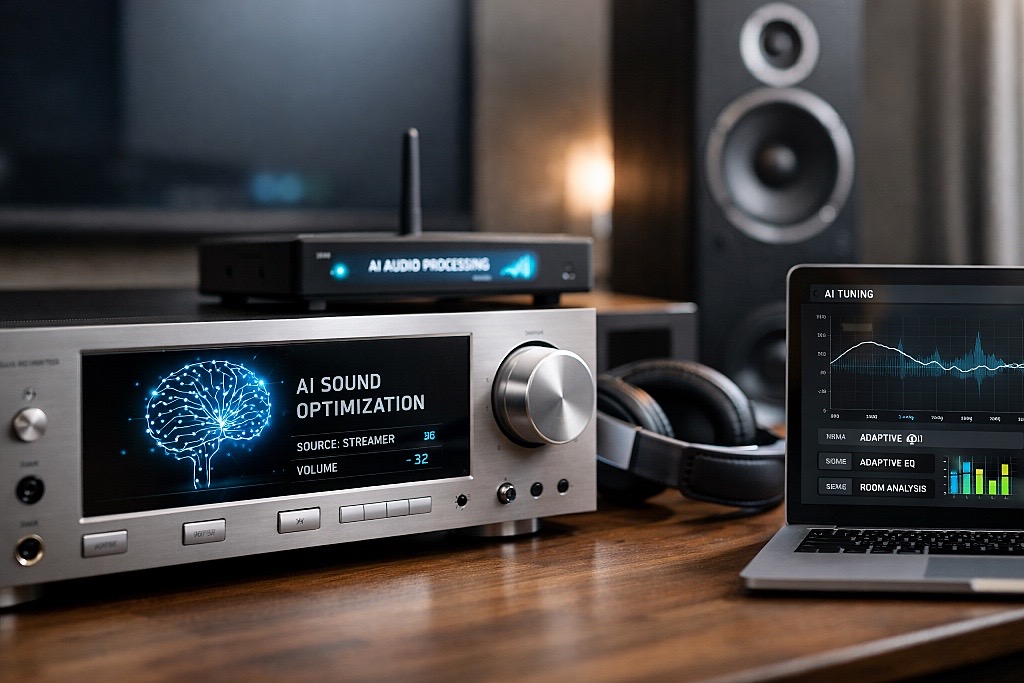
Even so, it can still be quite clever. A device might, for example, learn from your usage patterns, automatically calibrate a listening room, or detect when something in that room changes.
So when AI appears in consumer electronics, you do not have to worry about it “taking over the world.” In many cases it simply represents a useful algorithm-based addition. One potential downside is that some devices may communicate quite extensively with servers operated by the manufacturer. But that was already happening long before the arrival of AI or ML. In other words: nothing fundamentally new under the sun.
Can be useful
Whether AI is always a valuable addition remains open to debate. However, when it is used for things such as recognizing patterns in music preferences, it can be quite convenient. In that way, playlists containing music that suits your personal taste can be generated quickly.
Another practical application is automatic sound adjustment, as found in some portable speakers. This can subtly improve the listening experience, making a compact speaker sound larger or more balanced than its physical size might suggest. Here again, the technology involved is usually a form of machine learning, although that term is far less familiar to the general public.
No need for concern
So there is no reason to be alarmed when you see the term AI on a device. It can certainly improve ease of use. At the same time, it is wise not to expect miracles. Think of it more as a kind of audio assistant—and, if all goes well, one that you can switch off whenever you prefer.