




Intro
Contents
We hope the Q doesn’t stand for Quantum, because that hype really doesn’t make sense. It’s a bit like the AI hype. Everyone wants it and it gets stuck on everything, without people having a clue how it works or what it does. Anyway: we digress. Let’s take a look at the QRT QWave and QRT QSine. Two ‘plug and play’ plugs with very different functionality!
Energy is a pretty hot topic these days. With an explosive growth of charging stations, solar energy, home batteries, heat pumps and not to forget: LED lighting and switching power supplies, the power grid is under stress. This is not an assumption, just a fact. And this pollution is certainly a problem for us HiFi enthusiasts.
Filter
Now filters have been on the market for quite some time. Brands like Torus, Isotek, PS Audio and Isol8 have been around for quite a long time. And in the pro world, Furman, for example, is a big player. More brands have joined in recent years, including Yeti, Audioquest and, for example, Nordost, and Pura. This is not a total overview, as you will understand; there are an unprecedented number of brands.
Now filtering is a method to clean up the mains a bit. However, it is important to realize that there are numerous ways to get rid of polution. Roughly speaking, there are two ways to go about it: serial and parallel. Serial is completely in line with the equipment: it is literally “in the circuit” between the connection in the wall and the equipment. So the current really has to pass completely through the filter.
This is not the case with parallel: the filter is not completely in line with the connection in the wall and the device. It actually stands “next to” it and draws noise (especially high frequency) to ground. This happens with capacitors between earth and neutral and phase and neutral, for example.
The advantage of serial filters is that they can clean up more low frequency: it is more broadband. However, they can also be too enthusiastic and also make things feel a bit slower.
Parallel filters have the advantage that they are not in line and therefore do not slow things down. However, they work less broadband; there is less cleanup.
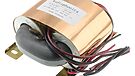
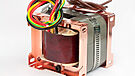
Another method of serial filtering is to use large transformers. Toroidal transformers are nice and quiet and mostly efficient. However, the filtering capability is very dependent on the construction; the winding. Capacitive coupling can be reduced with better screens.
Block transformers – aka EI-core transformers – have less leakage than a toroidal core because of the layered construction. Exactly what we want when we’re filtering. These are also available to specification when used as isolation transformers. The same goes for so-called R-Core, C-Core or UI-Core transformers. These transformers are in some cases even slightly better than EI-core transformers. Although it also comes down to component quality, specification, integration, et cetera.
New methods
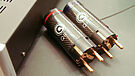
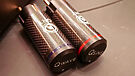

What we are also seeing now are plugs such as the QRT Qwave and QSine. These generate signals with a chip that are supposed to reduce noise. Think of it as anti-noise, but for mains.
“The QSINE enhances the AC signal in a sound system by introducing a specific frequency field onto the circuit path. This frequency field indirectly reshapes the sine wave, which, in turn, lowers the effects of EMI noise embedded into the AC power, positively impacting the listener’s perception of the musical signal. Introducing the QSINE into your sound system brings about several distinct benefits”
Looking at what Nordost says about the Qwave:
“The QWAVE manipulates the sine wave by introducing a precise range of pulsed frequencies onto the AC line, clocked from the original 50 or 60 Hz waveform. Through this manipulation, the QWAVE is able to better control the harmonics and overtones attributed to many improvements, not least of which is the enhanced realism of both the musical and visual aspects of performance. As a result of integrating the QWAVE into your sound system, you can expect several noticeable results.”