



Listening with the Eversolo T8: its qualities
Contents
Coincidentally, a Weiss Helios reference DAC was visiting. The perfect opportunity to put the T8’s qualities under a magnifying glass. A review of the Helios by colleague Yung will be a future publishing.
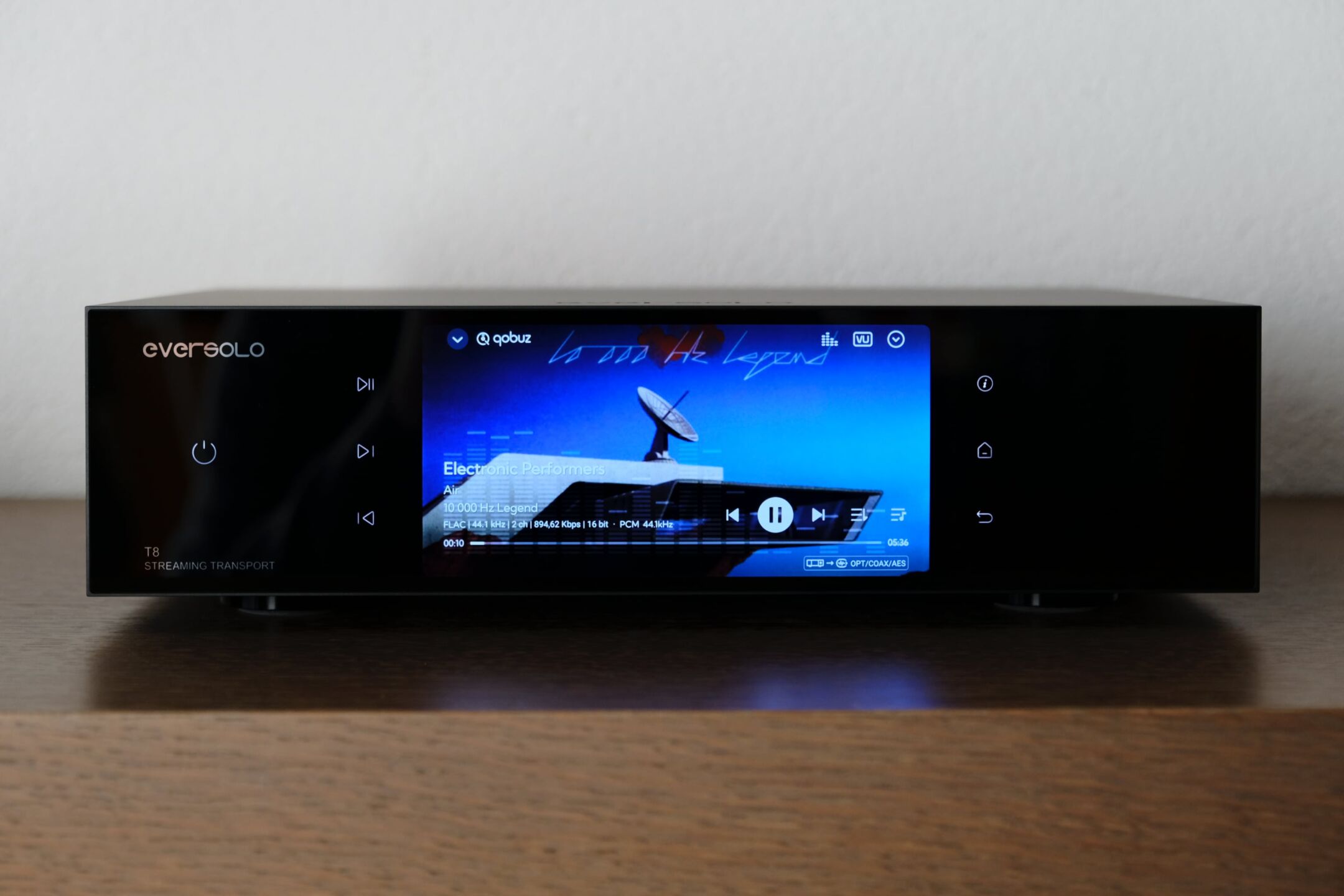
Qobuz Connect and Qobuz in the Eversolo app
The audible difference between playing music from Qobuz using the Eversolo app or screen, or Qobuz Connect is to be found in nuances, but is still audible.
The track “Be Forever Like A Curse” by Fink has a strong rhythmic drive, with the strumming guitars and repeating patterns with small variations. With the Eversolo app, there is more space in the highs, making the soundstage seem larger and the music breathe better. There is also more nuance and detail in voices of the singers. The saxophone in Vega Trails’ track sounds less metallic, more like a reed instrument.
To put it in context, the same Fink song played from the NAS via the Eversolo app sounds much better. This is especially audible in cymbals, which sound less dry and harsh, and in the rhythmic drive. The track should progress ‘stepwise’, in a forward motion, and that is a bit lacking with playback via Qobuz. It feels more stop-go.
The quality of the digital clock and of the connections on the Eversolo T8.
The Weiss Helios DAC is of impeccable quality on all digital inputs. This makes it possible to test the quality of the T8’s clock and the quality of its connections. In a connection via SPDIF (Coax, TOSLink or AES/EBU), the clock of T8 is leading, with USB the clock of the Weiss.
Two test tracks were put on the Eversolo T8’s internal storage to minimise network influence.
In Fink’s ‘Be Forever Like A Curse’, using USB the track’s dynamic build-up washes over you. The sound is full and rich. Using AES/EBU, this is a hair thinner in sound, but the main difference is that the emotional impact of the song’s build-up and dynamics is less palpable. Sound-wise, the difference is not that great. Rather, it is the observation that the USB output of the Eversolo T8 is well isolated and that the clock is on target for the price level, insofar as that can be judged by ear.
With Vega Trails ‘Epic Dream’, it is audible using USB that the sound is a bit fuller and richer, especially in the saxophone, than on AES/EBU. The timing of plucking the strings of the double bass is just as good on both outputs. The perception of the size of the church in which the recording was made is better via AES/EBU, but this is where the difference in cabling comes into play. The Grimm TPR XLR cable gives a different result than the Audioquest USB Cinnamon cable. Again, confirmation that Eversolo offers a technically sound streamer.
Do I recommend an Eversolo T8 to the lucky owner of a Weiss Helios DAC? No, the UPnP capability on the Helios itself is better. But this is not the purpose of the review. Eversolo lives up to what they advertise on their website.
The quality of CD rips
This reviewer rips CDs with an Apple USB CD drive and uses the software XLD for this purpose. Comparing the rip of Joe Jackson’s “Body & Soul,” made with the same CD drive on the Eversolo T8, with the XLD rip, shows a minimal difference in quality. The version made with XLD is slightly more detailed, but you have to listen with concentration. Sound-wise, the CD rip with the Eversolo T8 is fine.
Dank voor de review. Net een paar genelecs 8351b hier thuis. Zat naar deze eversolo te kijken als vervanging van nog een oude Sonos streamer en Leema versterker die nu nog alleen als voorversterker wordt gebruikt. Je review zet me op andere gedachten. Wat zou een alternatief zijn?
Alternatief voor wat? De Sonos streamer zou je sowieso moeten vervangen.
In ieder geval de Sonos maar de versterker kan ook omdat de genelecs actieve speakers zijn. Die kunnen zowel analoog als digitaal (aes) worden aangestuurd. Cd’s blijven we doen, lp’s zelden.
Welk aspect brengt je op andere gedachten? Dat is wel belangrijk voor het kunnen maken van een aanbeveling.
Het “ingetogen” en ik meende ook ergens “minder warm” gelezen te hebben maar kan dat niet meer vinden. Lastig die termen trouwens omdat we daar niet per se het zelfde bij hoeven te ervaren.
Genelecs zijn studio monitoren. Nu heb ik deze nooit gehoord, maar het kenmerk van studio monitoren is dat ze vaak helder en transparant getuned zijn in het midden en hoog, zodat je goed details waarneemt voor het werk dat je er mee doet.
Dan kan het zomaar zijn dat een Eversolo streamer dat net even tempert, wat voor thuisgebruik wel eens prettig kan zijn. Een andere aanbeveling kan dan de Volumio Rivo zijn. Niet de plus versie, ik vermoed dat de combinatie met Genelecs dan erg aanwezig gaat klinken, maar de Rivo zonder plus.
Er is sinds kort ook een Eversolo T10 uit, maar die hebben we (nog) niet gereviewed.
Goed punt van dat temperen. Detaillering is ongelooflijk inderdaad. Ik ga ze eens bekijken. Dank je!
Besloten om eerst eens langer door te luisteren en de speakers beter te leren kennen. Er hangt al een goede cd speler aan en t klinkt erg goed. De Sonos connect klinkt niet eens verkeerd maar verschil met cd is goed aanwezig. Nogmaals dank voor de tips.
Dank voor deze fijne review. Helder en to the point. Ik heme altijd algevraagd wat de geluidsmatige invloed is van een transport op de rest van de keten.
Zelf heb ik momenteel een Aurender a100 met een Leema Tucana II en de Raidho X1 (met dank aan Jaap voor de destijds mini review van de speakers)
Bekabeling is Shunyata en Crystal Cable. Na het beluisteren van de Denafrips Pontus 15 zit ik er sterk aan te denken on deze in mijn setup te plaatsen en de a100 enkel als transport the beluisteren. Dan rijst dus de vraag in hoeverre de a100 invloed heeft op het totale geluidsbeeld. Het mooie van de Eversolo en de a100 is dat ze een interne opslag hebben en zodanig als server dienen wat sterk mijn voorkeur heeft plus een gedegen interface voor zoeken en afspelen. Jammer dat Auralic gestopt is wat dat betreft. Bedieningsgemak is ook deel van de belevenis . Waarin zit ‘m het klankmatige verschil tussen a100 als transport en de Eversolo? Apple Music is trouwens wel een plus maar geen dealbreker.
Dag Peter. Ik heb ze nooit naast elkaar gehoord, dus daar kan ik niet zoveel over vertellen. Bij transports is dat wel nodig.
Ik heb de specs van de A100 nagezocht en ik vermoed zo dat je beter je Aurender kan behouden, omdat ik denk dat je niet veel gaat winnen en er misschien wel wat bij te verliezen hebt klankmatig.
Bedoel je geen Pontus of geen Eversolo?
Geen Eversolo T8 om de Aurender A100 te vervangen, want daar gaat je comment over.
De Aurender is een geweldige streamer/Dac. Het leek me zonde om deze enkel nog te gebruiken als transport.
Je bent me kwijt.
Ik citeer uit je eerste bericht: “Na het beluisteren van de Denafrips Pontus 15 zit ik er sterk aan te denken on deze in mijn setup te plaatsen en de a100 enkel als transport the beluisteren. Dan rijst dus de vraag in hoeverre de a100 invloed heeft op het totale geluidsbeeld.“
Ik snap de verwarring, mijn excuses
De Eversolo leek mij een alternatief voor de Aurender, mede vanwege de optisch aansluiting en I2S.
Aan de ander kant is de opbouw van Aurender rock solid en kan nog een tijd mee. Ben er dus nog niet helemaal uit, Aurender, of een dedicated transport. Eerst de Pontus / Aurender combo en go from there…
I find this comparison very partially. In my opinion, there are significant differences in transports and DDCs depending on the interface used. The T8 has an I2S interface that I consider superior to the others (USB and AES), so a DAC capable of making these comparisons was needed, which are crucial to the final result and therefore also in choosing the best audio device. I’m sorry because I consider your site one of the most serious and professional.
Could you consider doing a second part when you will have a DAC with an I2S input?
Wait for the Z10 review.
An I2S-connection is not magic. Originally, the I2S-connection was made voor inter-ic-onnectivity. Not for external connection with long cables. The difference is that clock and data are seperated. And that the dac becomes leading (and that actually says that the source is not that great). The shift in ‘master’ and the fact that clock and data are seperated can result in more calmness and for example more control. And maybe better focus. So, of course we recommend you try it. But it doesn’t change the complete characteristic of the dac.
I really wish Qobuz would fix the “connect sounds worse compared to native streaming” issue. It’s clearly not hardware (read: streamer) related.
I guess the connect feature is a software package maintained by Qobuz and provided as is to streamer software builders (like Volumio). An integration into their own software of a streaming services is coded and optimised by the manufacturer of the streamer software.
Met verwondering deze review gelezen. Ik denk dat het een gemiste kans is dat de FSP aansluiting niet is gebruikt. En ook heel raar dat er met geen woord over wordt gerept…… Je mag toch verwachten dat een innovatieve functie op een streamer wordt bekeken en uitgeprobeerd. Jammer. Ik denk dat de T8 en de lezers daarmee te kort zijn gedaan.
Ik verwijs graag even naar de review van de DMP-A10 voor de verschillende netwerkaansluitingen. Er is niets ‘innovatief’ aan, Eversolo heeft hetzelfde al in andere spelers eerder gedaan en ze zijn niet de enige en zeker niet de eerste fabrikant die een fiber netwerk aansluiting bieden.
Het is ook slechts een onderdeel in wat de speler maakt.