


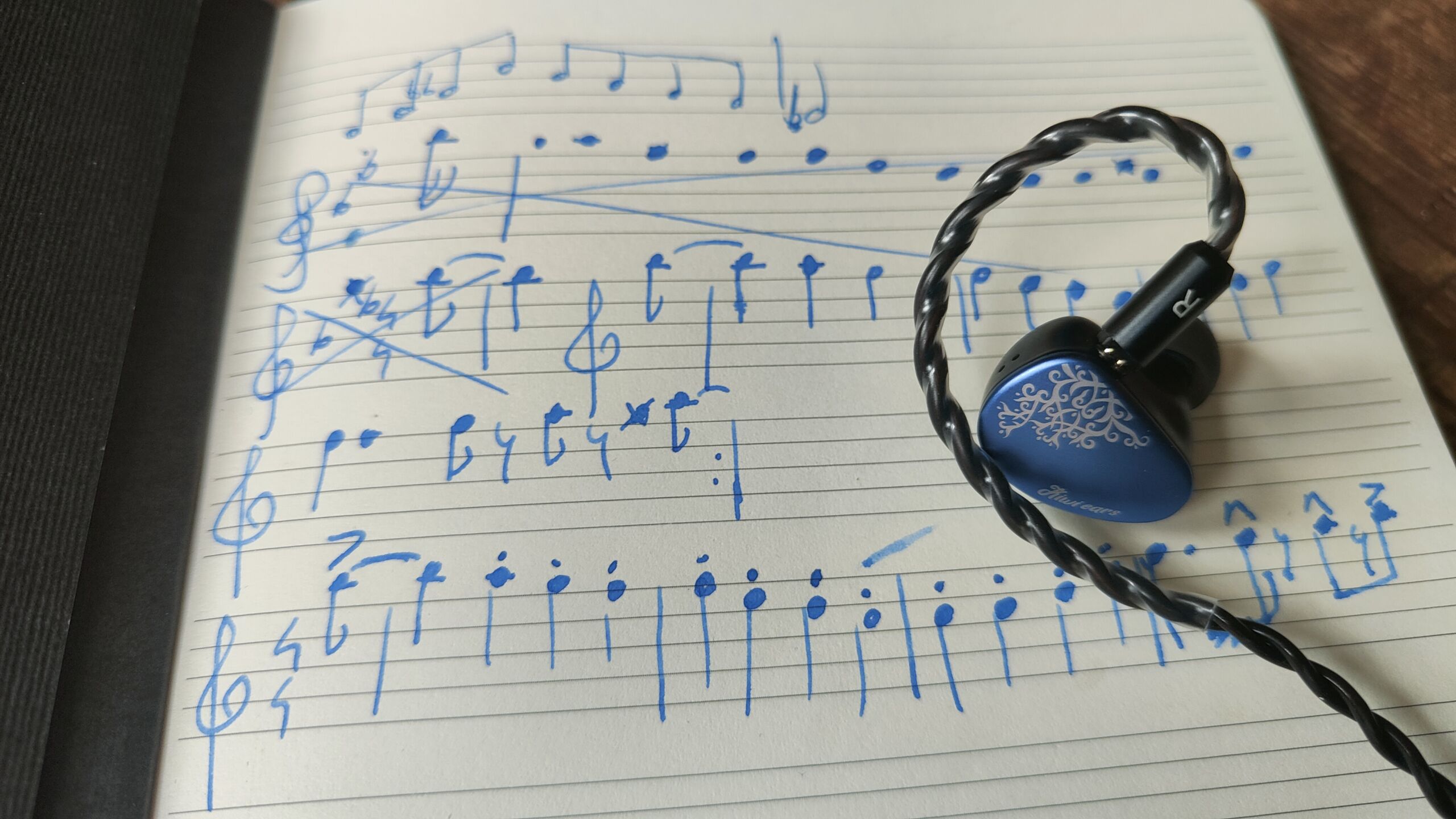
Listening to the Kiwi Ears Cadenza II
Contents
At the time of writing, it is around Easter, we find ourselves listening to classical music and especially Passion Music. We have discovered a brand-new recording of Bach’s St John Passion, performed by the Pygmalion Ensemble conducted by Raphaël Pichon. Both the choral and orchestral sound beautiful and well balanced.
We can tell it is a modern recording when we then listen to Mendelssohn’s 4th Symphony, performed by the Berliner Philharmoniker under the baton of Lorin Maazel. A recording from 1960. Unlike modern recordings, only a few microphones were used here, and these were positioned and adjusted very skilfully and precisely. Modern recordings in classical music are made using many microphones and multitrack recording so that errors in the recording can be corrected. This makes them increasingly akin to studio recordings of popular music (rock, jazz).
What is somewhat lost is the rendering of the ensemble; the overall sound and atmosphere, the acoustics of the concert hall. Listening to Mendelssohn, those hall acoustics are very clearly audible, and what’s remarkable is that the details are also audible, such as the bowing of the violins or the initial notes of the woodwinds. This is what we experience in a live performance, and somehow old recordings manage to convey this better.
And why are we writing all this down? Well, because the Cadenza II in-ears let you hear all of this. The timbre, the texture of an oboe and the spatial information of the recording are reproduced well – precise, fast and balanced, but never excessive.
Even when listening to music by The Carpenters, we can hear just how well produced it all is. The recordings and arrangements are sublime. On the IEMs, we can hear the reverb on Karen Carpenter’s voice beautifully. On ‘Rainy Days And Mondays’, the bass guitar comes through, with the plucking of the strings clearly audible. As my colleague Martijn described it in a review: if there is a sense of space between the notes, then it is spot on.
We listen back-to-back to Seal’s Standards album (2017) and Julie London’s “Feeling Good” (1965). Here too, we hear how different old and new recordings sound. Seal’s reinterpretation of Sinatra’s greatest hits, recorded in the same Capitol Studios in LA, sounds wonderful. There is absolutely nothing wrong with it. Julie London’s album isn’t necessarily very well recorded, but somehow we are drawn into the music. And you guessed it: we are hearing it all on the Cadenza II from Kiwi Ears.
Coincidentally, ‘Spiral Stairs’ by Mammal Hands appears in the playlist. We use this track to test the dynamic range. It features plenty of bass punches and spatial effects (percussion). On a large system like the Tannoys in the studio in Leiden, this is very clearly audible; and on the Cadenzas too. We switch over to Ojos de Brujo, the Nuevo flamenco ensemble. Incredibly frenetic music where it is hard to keep track of everything. Strangely enough, we can’t quite get the bass right on the Cadenzas, even though it is definitely there and sounds beautifully deep and defined on Mammal Hands.
Who is the Kiwi Ears Cadenza II for?
In this review, we have mainly listened to music, and that is a good sign. In-ear monitors sound good when the tuning matches the listener’s taste. Some will want to hear more bass punch, others more treble and soundstage, or perhaps a nuanced midrange.
The second factor is the ‘fit’. Does it fit well? With IEMs, this is extremely important. The ear tips must seal the ear but not completely (as this creates a sense of disconnection); they must not pinch but also must not sit too loosely (as this results in insufficient bass). It is also preferable for the IEM to be small and lightweight; this enhances wearing comfort, and with lightweight, compact in-ears, it is also easier to position the ‘earpiece’ precisely.
The Cadenzas are therefore suitable for people new to in-ear monitors. More experienced users can take the next step with balanced armature models. These are generally larger and more demanding in terms of fit than smaller types. The neutral tuning makes the Cadenzas suitable for a wide audience.