



Listening to the Arete II
Contents
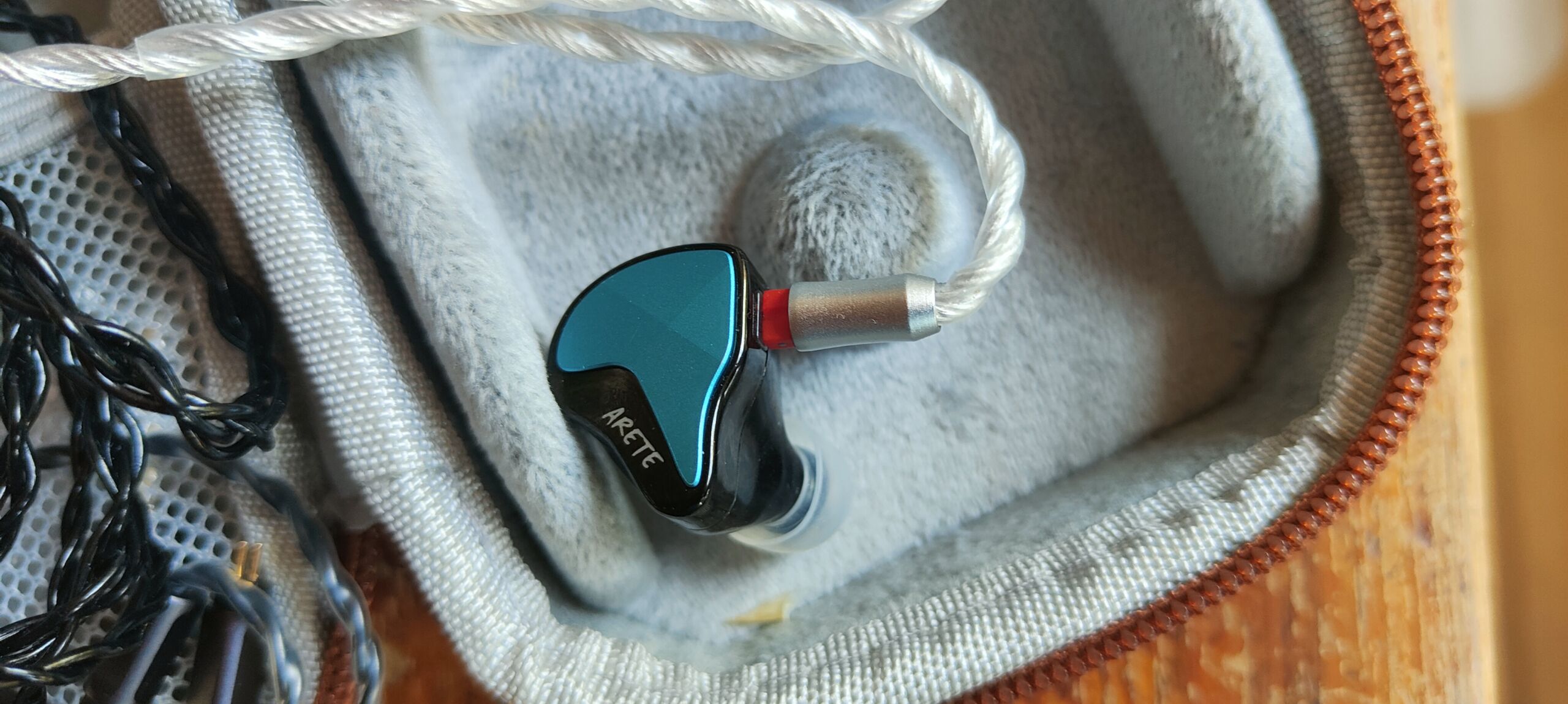
We find the supplied cable a bit thin and, as a result, prone to transmitting contact noise (microphone effect); we feel that it doesn’t get the most out of the Arete’s potential. That is why we used the cable from the previously tested Kiwi Ears Orchestra II. And indeed, with this cable, the sound was much more balanced.


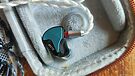
We cannot stress this enough: with in-ear monitors, the choice of ear tips is crucial. First and foremost, they must fit comfortably, but they must also provide just enough isolation. If the ear tips do not fit properly, the IEM sounds thin or, conversely, far too bass-heavy. There is no balance; it is tiring. When testing in-ear monitors, a lot of time is spent choosing the right ear tips. Certainly with in-ear monitors costing upwards of around 100–150 euros, it’s worth investing in good-quality ear tips! We have the Flight from Campfire, a sort of tea box containing a wide variety of tips. So far, we’ve always been able to find ones that fit well.
Bass
We’ll start with the lower registers. We can indeed hear that the subwoofer (the dynamic driver) goes very deep. The Arete II features something interesting; a dipswitch that opens or closes the IEM’s bass port. This works surprisingly well; open results in a deep and full bass, closed is somewhat tighter and more controlled. Nice! The track “Giorgio” by Daft Punk (from ‘Random Access Memories’) features a Moog synthesiser at the end of the track that sweeps from high frequencies down to low. It ends with a kick (bass drum) which, if done right, sounds very layered. The Arete IIs let us hear it layer by layer. If we screw the in-ears in properly, it all goes even deeper.
We play “Rim Shot”, the opening track on Erykah Badu’s live album. After 1 minute, the bass goes down to C2, two octaves below middle C and a frequency of 65.4 Hz. This is reproduced very convincingly and without distortion. We notice the emphasis on the lower registers particularly when listening to Air’s album Moon Safari. The beauty of it is that the bass doesn’t overpower the midrange and high frequencies. In fact, it seems to give more space to the midrange and above. We hear this, for example, in the texture of the keyboards in the track “All I Need”. Despite the heavily emphasised bass, it is well-placed and excellently defined. The distortion of the keyboard is beautifully rendered.
Midrange
The Arete II is intended as a gaming IEM. Now, your editor is no seasoned gamer, but he is a lover of game music, which sometimes contains real gems. Such as the music of Koji Kondo, who composed and produced the music for Nintendo titles including Super Mario Bros. and The Legend of Zelda. Yours truly did play some of this music with a project band years ago, and only then did it become clear just how skilfully his music is put together. And how difficult! After playing “Dr Willy’s Castle” (Megaman 2), I was definitely ready for a break.
Live performances (and recordings) of game music have now become a category in their own right; whether with a band, an orchestra or ‘in the box’, it can all be found on streaming services. We listen to a few versions of The Legend of Zelda via the Arete II, and of course to Mario music. We come across a compilation album featuring the original versions of the Nintendo themes, in 8-bit sound quality. This turns out to be an excellent test case for the midrange, which will come as no surprise to you. With the Arete II, we are completely immersed in the music (and the game) even without a picture. The original versions are Super Mono, and that doesn’t matter at all – quite the opposite. It gives the sound a pleasant punch and a kind of compression.
Highs
For the high frequencies (and the soundstage/reverb), we start with Bach’s well-known “Little Fugue”, performed by Jacques Loussier. We usually use this track to assess the bass and piano, but the drum’s cymbals are also interesting, as is the reverb used. This track was recorded and mixed so closely that it can quickly sound ‘larger than life’. The piano is all over the place, the session room has become a ballroom, and the reverberation is everywhere. When listening to this track, the first thing you notice is the sound of the double bass. On the Arete II, the overtones and texture of the bass are beautifully audible. That is remarkable because the kick drum and the root notes of the bass are usually (too) dominant and demand attention. Not so with the Ziigaat Arete II; it sounds well-balanced. The reverb also sounds natural, just as we’ve heard with good monitor speakers. And the piano is well-proportioned too.
Piano
We’re trying some piano music because we’re curious to see what else these in-ears can do besides playing game music. We’re listening to pianist Anna Fedorova playing music by Gershwin (preludes), a release from Channel Classics. It sounds surprisingly balanced. Although there’s a lot of low end in the pieces, the bass doesn’t dominate. The piano sounds like a piano. That sounds like stating the obvious but it isn’t. A piano is difficult to record due to its wide dynamic range, the instrument’s dimensions and the influence of the hall acoustics. Recorded too close and you miss the resonance of the soundboard, the wood, the soundboard. Too far away and it sounds, indeed, distant. Anna Fedorova’s piano sound is reproduced excellently by the Arete II.
Conclusion
An IEM with generous bass reproduction, and remarkably enough, we don’t find it excessive. On the contrary, it provides a solid foundation on which the rest of the musical register can rest. We sometimes experience this with subwoofers in the listening room; the good ones do their job and thereby give the music space.
This Ziigaat Arete II seems intended for gamers and has been marketed as such. In doing so, Ziigaat does this IEM a disservice. Yes, it will be fine for gaming, but also for classical solo piano. The bass-mid-low balance is excellent. It’s particularly lovely to simply enjoy listening to music, and the fact that this is possible with a solid bass is what sets this IEM apart. Definitely worth a try!