




We have long been curious about the influence of fiber converters in a network, the sfp modules used and any noise modulation when converting electrical signals to light and visa versa. Sounds all very complicated, but it’s not that bad, to be honest. Let’s explain.
In a “normal” network, you connect devices either wirelessly or with a cable constructed with four wire pairs: 4 x 2 twisted pairs. These cables fall into a certain category: CAT5, CAT5e, CAT6 or perhaps CAT7 or even CAT8.
We have already shown that a network not only carries data from A to B, but also noise: common mode and differential mode noise. This noise can be detrimental when it enters your streamer. We have already shown this in measurements. It is also audible, so simply trust your ears.
Optical
An effective method of keeping out noise is to build an optical network. An optical network uses fiber optic connections. Exactly: those connections that are also increasingly being used for high-speed Internet.
Now, fiber optics is not faster than a “regular” CAT6 connection. A standard fiber connection is also just 1Gbit/s or 10Gbit/s. Just like an ordinary copper connection. However, fiber optics within a network for audio is an effective way to keep out noise: after all, no noise can travel with the help of fotons… right?
The measurement setup
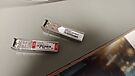
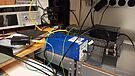
That’s what we wanted to find out. After all: a converter converts data to light pulses. But what if noise is also converted during that conversion? Can noise also be modulated? If only subtly.
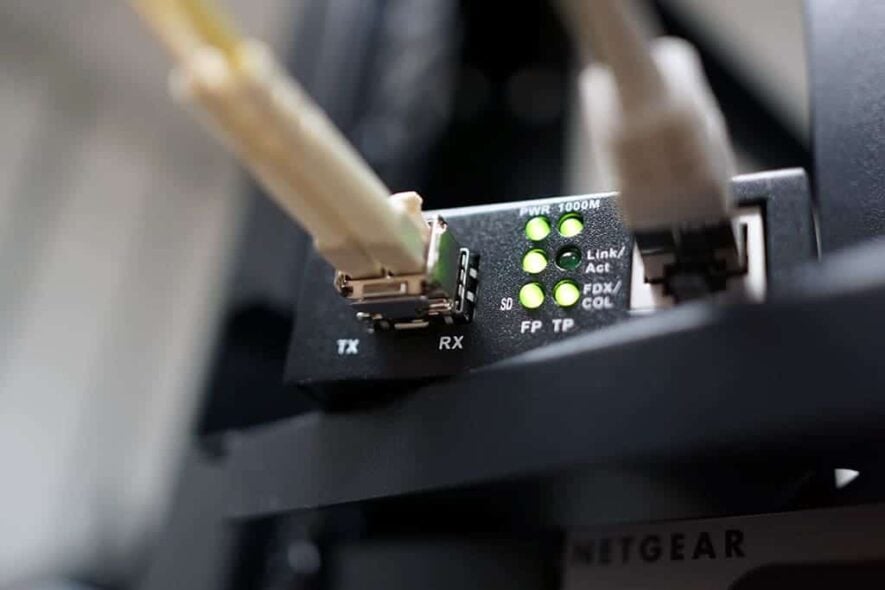
For this first look at this topic, we’ll take a simple approach. We take our Delock SFP converter and connect it to a Dlink 1210 smart-switch with two SFP slots. Into this switch we can also inject noise: 400mv of white noise. Purely to see what happens.
We measured with a module from SF and an AGM module that is Netgear-compatible. Both support speeds up to 1Gbit/s.
We measured at the output of the Delock SFP converter. We split the noise into common mode and differential mode. We set the Picoscope 5000-series to a bandwidth of 30 KHz – 5 MHz.
Baseline – SF versus AGM module
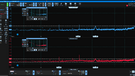
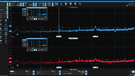
Let’s start with a baseline. We measure both the AGM module and the SF module without any noise injection. The difference is visible: the AGM module is quieter than the SF module! It even makes a difference of 7dBu in noise…. Conclusion: there is difference in modules when you look at the noise floor.
Added noise
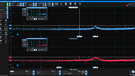
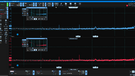
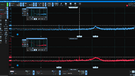
But what if we start adding noise? We inject 400 mv of white noise (up to 60 MHz) through the Rigol function generator. That’s a lot and quite strong. So take this with a grain of salt.
However, anyone who thinks that no noise can come in over a fiber-link: that is not true. The noise floor does rise when we inject noise on the side of the Dlink 1210. The only conclusion is that some of this noise is also converted to light and is also converted back to electrical noise on the other side. Fascinating!
Conclusion
Although a fiber optic link blocks noise much better than an electrical network link, it is not immune to noise either. No: not much comes along, but our first tests show that even fiber converters need a ‘clean’ connection. So again: clean power on both sides does make sense. And yes: the module also matters.
Given the discussions below, I cannot help but to wonder if anyone has read the article or understands what is written.
Let me try to rephrase it, so it might be understood. Forgive me for the non exact, non scientific, non electrical engineering language, but it boils down to this:
One takes a switch with both regular and optical ethernet ports. One injects generated noise from a lab device into the signal going in to a regular network port, which travels through the switch and is converted from an electrical signal into an optical signal and measure what comes out on the optical side. Et voila, it is measured that a remainder of that noise is converted into the signal. Proof: noise isn’t completely blocked out in the conversion process.
Obviously, the lab setup has clean power and decoupled networks, otherwise it is hard to take a clean measure.
As said in the article: there’s a lot of noise injected, so not representative for a real life scenario, but that’s not the point. The point is: noise once captured in the signal itself will travel through later conversion steps as well.
This is a risk that can happen and often happens every time a digital music signal — which is nothing but a series of very tiny voltages changes spaced out in time — is converted. Being it the conversion of the signal itself, or when you apply format conversion (FLAC to PCM for instance), upsampling etc.
Once in the signal, it is hard to filter it out again. Something that every designer of a streamer or DAC we have spoken to over the years has confirmed.
And this is just only 1 aspect of the problem.
But as Guido Tent has told us many, many times: much of the problems and solutions have been described in the literature in the 50s and 60s of previous century. You just have to read that literature, understand it and apply it as a modern day designer. (There are interviews on the Alpha YouTube channel where he repeats this if you want to check it out.)
What we ask ourselves is if the switch and the lab device is connected to the same power line/grid?
In theory the noise could spread over the power line, we are thinking? But maybe your powerlines are separated?
I apologize if this information is in the article, but I can´t see it.
No… the tested device is completely isolated. From the network ánd the power grid.
Thanks! That is what thought.
I was asking more because others where sceptic here.
I found out that the SFP/SFP+ modules that sound best are: 1310nm (10-20km reach), Industrial grade (80/85 max C temperature – I presume they are using glass lens instead of plastic), Single Mode fiber (grade B connectors are better).
This perfectly explains the fact that I heard increased reduction in noise when daisy chaining multiple (3x) fiber patch cords and media converters.
Electrical noise can’t be transferred over fiber optics – no matter the nm value. The fiber-to-electrical (e.g. ethernet) converter and its PS (after the fiber) generate its own noise. Different fiber-to-electrical converters generate different levels of noise which might explain you findings.
Logically i agree. But i have heard enough people saying that changes prior to fiber has an impact. I would also suspect that it would be thru the power line but I have started change my mind.
After all, it is a known engineering challenge to connect two systems with each other and avoid noise traveling between those systems. The moment they are physically connected, there will be noise transferred between them, almost regardless of how they are physically connected.
The streamer manufacturers are also saying similar things. If it was easy to stop the noise getting to the DAC, they would have done it long time ago.
Yes, i agree there is new noise created on the receiving end. I talk about increased noise when increasing it on the source end.
I don’t think the electrical noise travelled over the fiber optic, instead, it travelled over PS ground and/or phase coupling in the AC lines and/or through the shield/ground of the ethernet jacks/chassis to the other – electrical – side of the fiber optic where you measured it.
“Noise won’t ride the light” is just true.
This has really interested me! Thank you for testing the optical conversion. I’ve looked into some dedicated products along this line. Wondering if you could get your hands on one of these to test:
https://www.effe-i.com/
A couple more like this on the market from ifi and Stack Audio as well, but this one is in the middle in terms of cost / simplicity.
I use SONORE opticalRendu with i5 SonicTransporter from Small Green Computer. The music engine is Audirvana. It’s feeding an Ayre QB-9 Twenty dac that was fed from a Mac Mini before. While I am not in love with A. Gillis, I have to admit that this kit is extremely good. Very clean as claimed, but also, still nicely musical. The fiber cable run from a switch to the Rendu and via USB to the dac. (For info, the amplifier is Classé CA2300, preamp is Ayre KX-5, speakers: Verity Audio Parsifal Anniversary.)
Jaap, did any particular SFP module impress you more than another?
I just tested these two modules up until now… so I can’t say anything about that.
Jaap, those are MM (multimode) modules? At least the optical cable (cyan) is for MM. Please go for SM (single mode) modules with proper OM2 yellow cable jacket. Also aim for industrial grade modules (80/85 max operating temperature) and 1310nm.
Try different brands and lengths for the optical patch cord, you’ll be surprised 🙂
I’ve also experienced that single mode sounds better (less noise, cleaner sound), currently I’m using Adot transceivers, so Valentin, what brand and type of transceivers are you using? regards Arno
@Arno I tried fs.com and tp-link media converters with no big difference in SQ and in the end I kept the fs.com ones on which I upgraded the electrolytic capacitors (the sound became fuller and more energetic). As for transcievers I have settled to 1G FS.com and Cisco ones (SM, 1310nm, industrial), also I have 10G FS.com ones for the backbone of the local network. Using DAC cable (copper cable with SFP connector at the ends) brings the latency down a bit and the sound feels snappier.