






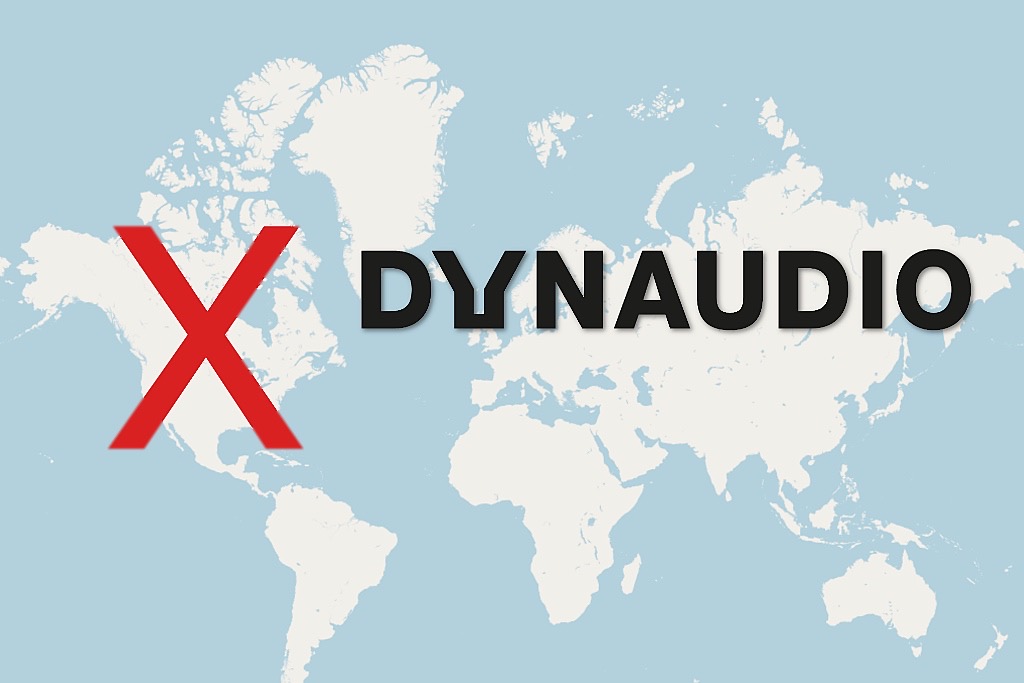
In what some U.S. websites have described as a “shocking” announcement, Danish loudspeaker manufacturer Dynaudio announced that it is ending its operations in North America.
While some commentators in the United States may regard the decision of Dynaudio withdrawing from the North American markets (see for example here and here) as surprising, many observers elsewhere are likely to see it as a logical consequence of current market conditions. Dynaudio has confirmed that it will cease its North American activities and close its U.S. subsidiaries.
The company has also stated explicitly that its long-term strategy is to focus on Europe and Asia. From a European perspective, that decision comes as little surprise. Ongoing U.S. tariffs, coupled with an increasingly unpredictable international trade policy, have made the American market considerably less attractive for many international manufacturers.
The move is undoubtedly disappointing for American consumers, as Dynaudio has long enjoyed a loyal following in the United States. Unfortunately, Canada and Mexico—also part of the North American market—will inevitably be affected by the company’s withdrawal.
Looking towards the future
From Dynaudio’s perspective, however, the decision appears to be a pragmatic business move. The company is strengthening its traditional European base while increasingly looking eastwards. And that a time when Asian markets are becoming ever more important. Not only for Dynaudio, but for many international manufacturers seeking alternatives to the U.S. market.
Global trade has changed, and this shift may well prove to be a lasting one. If the strategy delivers the expected results, there is little reason to expect Dynaudio to return to North America anytime soon. As the company itself describes it, this is a long-term strategy rather than a temporary adjustment.
Even if the political climate in the United States were to change in the future, a rapid return to the North American market appears still unlikely. Broader geopolitical tensions—including the recent US-initiated dispute surrounding Greenland—may also have played a role in the background. Although the company has not cited this as an official reason for its decision.