



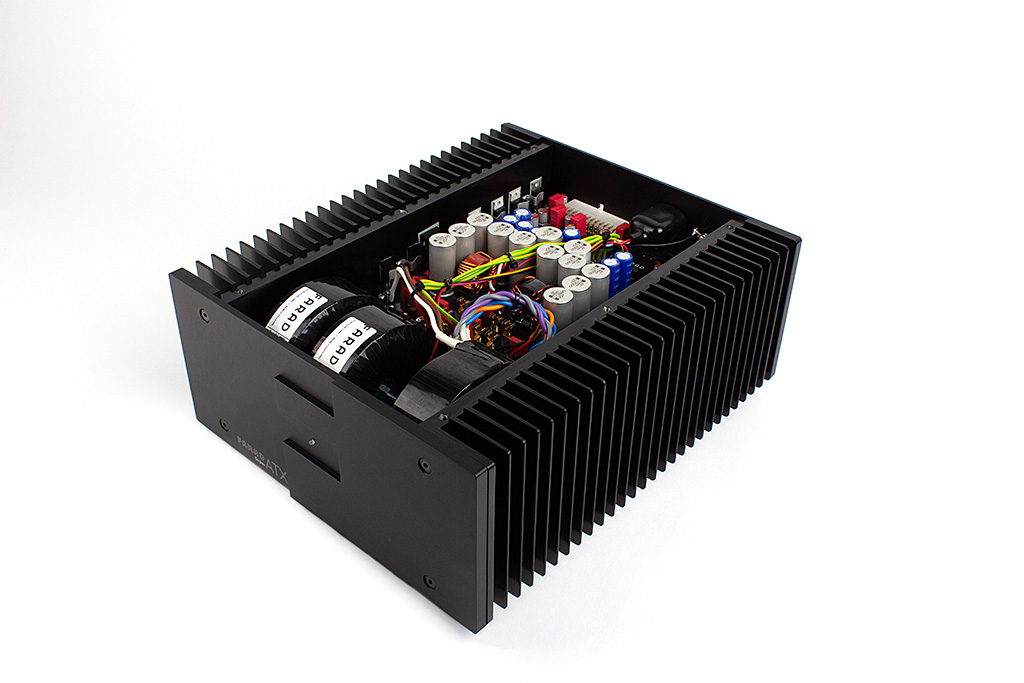
For those looking to provide an audio-focused PC with the cleanest possible power, the new Farad SuperATX linear power supply could be an ideal solution.
According to the manufacturer, the SuperATX has been developed from the ground up for high-end computer audio and “represents a completely new approach to ATX power design.” The company continues: “Built on Farad’s proven supercapacitor technology used in the already very well-known Super3, Super6 and Super10 power supplies, it delivers an unprecedented level of stability, isolation, and ultra-low noise performance—specifically designed for demanding audio servers and streaming setups.”
The SuperATX features three completely separate power rails: one dedicated to the processor, one to the motherboard and one to peripherals. According to Farad, this allows audiophiles and DIY enthusiasts to build an exceptionally high-quality computer-based music streamer.
The recommended retail price of the SuperATX is €4,089 excluding VAT.
ATX Cables
The SuperATX is not the only new addition to the Farad range. The company has also introduced a new series of ATX cables, including the L2-C ATX cable set.
According to Farad, these cables have been “engineered with the same philosophy as our power supplies: maximum shielding, optimal conductivity, and minimal interference.”
While designed as the ideal companion for the SuperATX, the cables are not limited to Farad products. They are fully compatible with ATX power supplies and DC-to-ATX converters from other manufacturers.
Whether upgrading an existing Farad system or improving another high-end audio server, Farad says the L2-C cables deliver a significant improvement in sound quality.
Technical Highlights of the Farad SuperATX
According to the manufacturer, the SuperATX offers the following key specifications:
- Proven technology derived from the Super3, Super6 and Super10 power supplies.
- Five-rail architecture with three custom-wound, triple-shielded 150 VA transformers: one dedicated to the CPU, one to the motherboard and one to SSDs, peripherals and clocks.
- Approximately 288,000 µF of smoothing capacitance using 105°C low-ESR automotive-grade capacitors with long service life and HF choke pi-filters.
- Twenty-seven 15 F supercapacitors, providing an effective 22.5 F of capacitance at full voltage—equivalent to a total buffer capacity of 22,500,000 µF before the final regulators.
- Dual low-noise voltage regulation with additional HF post-pi filtering for even lower output noise.
- Microprocessor protection on all voltage rails, including overvoltage, undervoltage and short-circuit protection, with communication to the motherboard.
- Ground-lift switch, grounding terminal and gold-plated Molex output connectors.
Practical Configuration
- Transformer 1 / Rail 1: 12 V / 8 A output for the processor (maximum 70 W TDP).
- Transformer 2 / Rails 2 & 3: Fully linear 24-pin ATX power supply, with outputs rated between 5 A and 8 A.
- Transformer 3 / Rails 4 & 5: Dual peripheral outputs providing 5 V / 3 A (5 A total) and 12 V / 3 A (5 A total). One output can be configured as always on, for applications such as motherboard clocks.
Further information is available on the manufacturer’s website.
As Farad concludes:
“So, the SuperATX is the power supply we dearly wanted back then as it would make our projects more thorough and boost confidence in the technical concept we we’re working on – it’s the power supply we use this very moment for our commercial R&D. In short, this power supply is a tribute to all you DIY-guys and gals!”