


Behind the scenes, work is well underway on new and improved Bluetooth standards. Audiophiles in particular can already start looking forward to HDT.
At present, the maximum Bluetooth data transfer rate is a rather restrictive 2 Mbps, or 3 Mbps in Bluetooth Classic mode. As a result, audio always needs to be compressed in some way. Numerous codecs are available for this purpose, some of which can provide lossless transmission, albeit at more or less standard CD quality.
However, to take a significant step beyond that, something needs to change about the underlying speed limit. And that is precisely what is currently being worked on. Bluetooth HDT should provide the answer by increasing the maximum data rate to 7.5 Mbps.
Naturally, that opens up some interesting possibilities for audio. It still isn’t enough for completely uncompressed transmission of hi-res audio, by the way. However, future lossless codecs could potentially help bridge that gap.
It is worth noting that simply increasing Bluetooth speeds tenfold—or something along those lines—isn’t really a practical option. Technically it could be done, but the resulting power consumption would become far too high. After all, Bluetooth was originally designed for low-power data transmission.
Audio applications eventually followed, although Bluetooth was initially used primarily for wireless earpieces intended for hands-free phone calls. Hi-fi sound quality played virtually no role at that stage. All of that came later. Now that the protocol has become firmly established in the world of consumer audio, however, its speed limitations are increasingly becoming a bottleneck. Hence the decision to raise the ceiling.
Work in Progress
It is not yet known whether HDT will become part of an entirely new Bluetooth version or whether it will be added to a future ‘point’ release, such as Bluetooth 6.x. Nor is it clear exactly when the feature will become available.
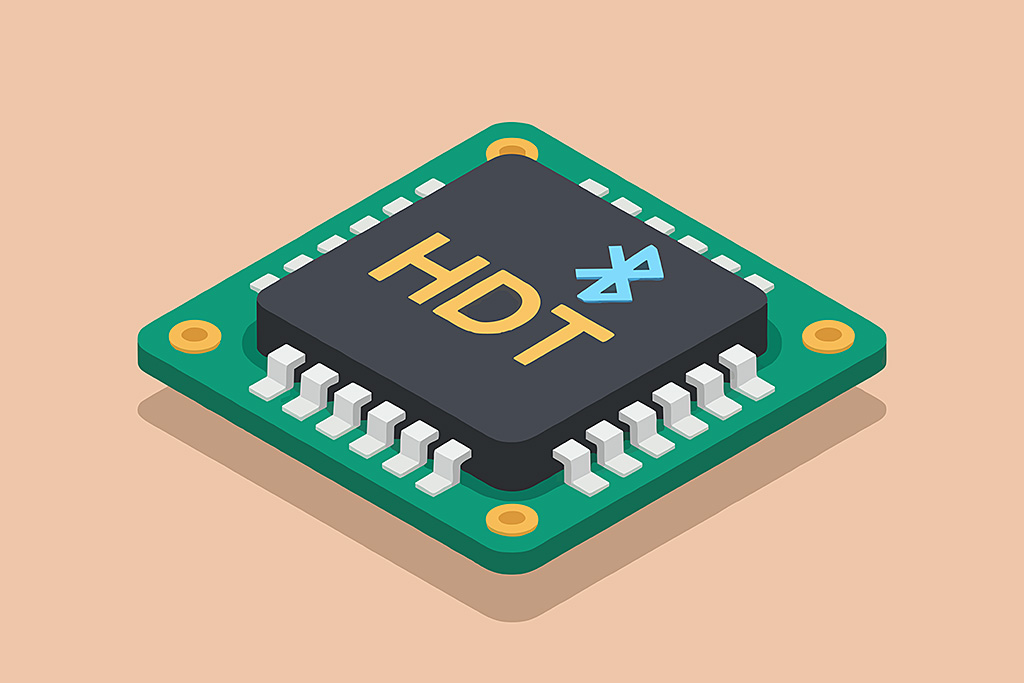
Meanwhile, several chip manufacturers are already working behind the scenes on ICs supporting HDT. According to Rohde & Schwarz—which is itself heavily involved with HDT and has even developed equipment for testing a future version of Bluetooth LE featuring the technology—Realtek is one of those companies.
Interestingly, another report suggests that the technology could eventually become part of Bluetooth 7. For now, therefore, we’ll simply have to wait and see.
Of course, once HDT does become available, the higher transfer rate will only work when both the source and receiving device support it. Consequently, it will probably take many years before these higher Bluetooth speeds become commonplace.