



The audio landscape is – to put it mildly – dynamic. There have been a great many changes in recent years; partly due to the arrival – and the disappearance – of Covid, which suddenly made hi-fi very appealing. Everyone was stuck at home, which led many people to upgrade their TV and audio systems. But those days are over. Add to that countless wars, and we see a new wave of unrest emerging. With the inevitable shifts that follow. We’ve done some research into exactly who owns what at the moment. Because, to be honest, we’d really lost track ourselves.
At first glance, the hi-fi industry appears to consist of dozens, if not hundreds, of independent brands. Look a little closer, however, and a very different picture emerges. Many of the best-known names in audio are ultimately controlled by a much smaller number of parent companies, investment groups and industrial conglomerates. Brands with completely different histories, design philosophies and market positions can therefore share the same ultimate owner.
Buy…. And sell!
The landscape has also changed significantly in recent years. One of the clearest examples is Sound United. Over time, the group brought together brands such as Denon, Marantz, Bowers & Wilkins, Polk Audio, Definitive Technology and Classé. Sound United was acquired by Masimo in 2022, but that situation did not last. The audio business eventually moved to HARMAN, which itself is owned by Samsung. As a result, an unusually large collection of consumer, professional and high-end audio brands now sits within the same corporate family.
McBose
The high-end sector has seen similar consolidation. Fine Sounds Group evolved into McIntosh Group, bringing together names such as McIntosh and Sonus faber, before eventually becoming part of Bose. Elsewhere, Focal and Naim operate under Vervent Audio Group, NAD, Bluesound and PSB belong to Lenbrook, while International Audio Group controls an impressive portfolio of classic hi-fi brands including Wharfedale, QUAD, Audiolab, Mission and LEAK.
Cross-pollination
Corporate ownership does not necessarily mean that all of these brands are becoming identical. In many cases, engineering teams, product development and brand identity continue to operate with considerable independence. A larger parent company can provide access to capital, manufacturing, distribution and shared technology while allowing individual brands to maintain their own technical character. At the same time, common streaming platforms, software, components and development resources are becoming increasingly important.
An overview
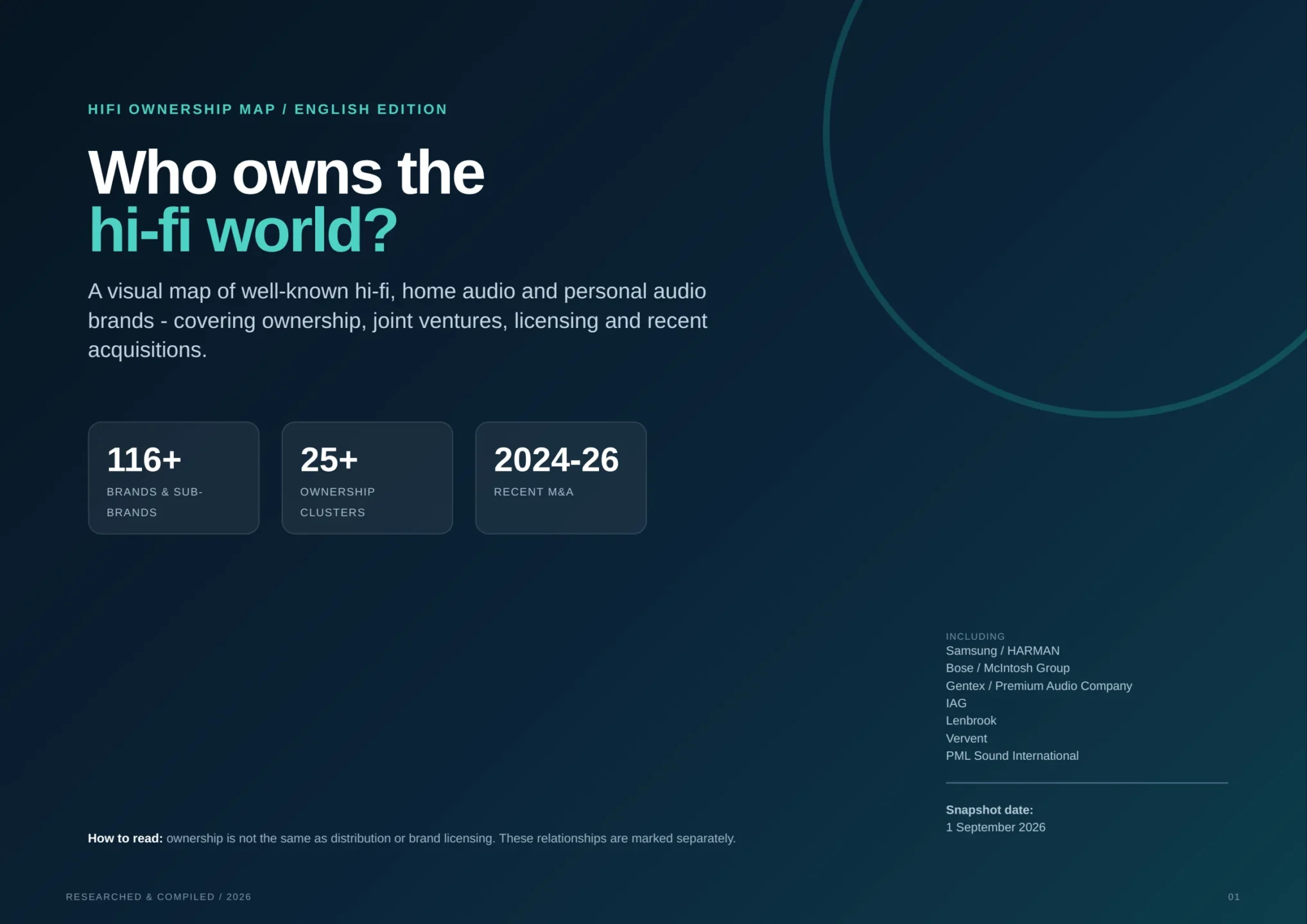
With this HiFi Ownership Map, we have tried to make the current structure of the industry as clear as possible. The presentation includes not only the major corporate groups, but also joint ventures, licensing arrangements, unusual ownership structures and a large number of independent brands. This distinction matters. Pioneer and Onkyo, for example, cannot simply be described as two brands with exactly the same ownership, while Sennheiser’s consumer activities have a different corporate story from its professional business.
The map reflects the situation around September 2026. In an industry where acquisitions and restructuring continue to happen regularly, any ownership chart is inevitably a snapshot in time. Even so, it clearly demonstrates just how interconnected the modern hi-fi industry has become.
Dag Jaap, heel mooi werk!
Bij Dali de opmerking dat Peter Lyngdorf daar wel de grootste aandeelhouder is.
Bij Focal/Naim: ja ze zitten onder Vervent Audio, maar die is recent in handen gekomen van het Belgische Barco.
Ow ja! Barco heeft Vervent Audio gekocht… Goede correctie! Dali blijft wel zelfstandig als de bronnen kloppen… Peter is idd groot aandeelhouder.