





Intro
Contents
Energy forms the base for everything. For people, transportation, comfort AND…. hi-fi. We dare say that if the power supply in a system is not doing its job well enough, the whole system will collapse. That’s why we pay so much attention to it at Alpha Audio. This time: the new Yeti Reference Source 250, a completely new model specifically for sources. Let’s take a look at it.
Yeti by now belongs to the established order. The brand has been developing and producing -mostly- filters and cables for years. And we’ve had quite a few on the test bench already.
This time we have the little brother of the Reference 1000 that we have had in our own reference system for some time. A nice filter which we don’t want to miss anymore.
Yeti Reference Source
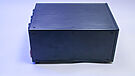
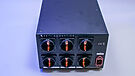

The 250 watt ‘Source’ version of the Yeti Reference filters is specifically designed for sources. The filter can be equipped with 4, 6 or 8 outputs. To be honest, 6 always seems sufficient to us. But who knows, maybe 8 outputs are needed in certain setups. We received a version with 6 outputs. The version with 4 outputs costs 2599 euros. The version with 6 costs 300 Euros more, so 2899 Euros. The version with 8 outputs will cost 3199, if we follow the price structure.
With a filter for sources, you immediately think of a compact, lightweight filter. But no. At 16x14x30 (wxhxd) and 17 Kg, this is not a small light filter. Although compared to the Reference 1000, 2000 or 3000 it is a feather weight and small device. The weight comes mainly from the transformer. But the thick plating of the housing also helps of course.
Yeti has its isolation transformers specially made to specification. The IEC outputs are also specially made to specification; they are all-copper, which has advantages. After all: no transition resistances from mixing multiple metals. The only disadvantage may be that copper is quite soft and wear may occur with some heavy use.
We also read in the specifications that Gigawatt cabling is used internally and that parallel filtering is used in addition to the use of an isolation transformer. This is to eliminate any leftover noise. The Yeti filters are completely hand-built in the Netherlands.
Balanced
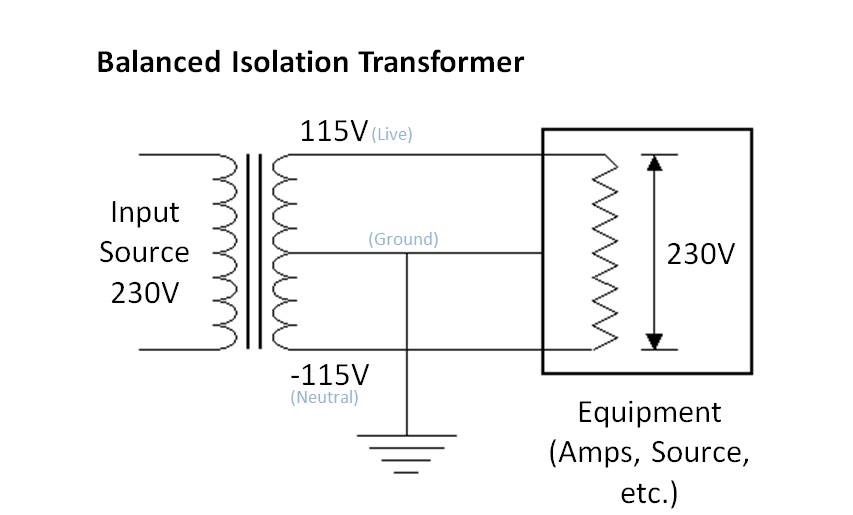
What’s nice about the Yeti filters is that they have a balanced construction. Like balanced amplifiers and XLR cables, it ensures that noise is suppressed. The transformer does this by putting 115 volts on both “live” and “neutral. Both wires lie symmetrically around ground. This pushes common-mode noise practically to zero. And that’s what we want in hi-fi land!
What’s also nice is that polarity no longer matters. We have tested this and we really hear no difference in our listening room. And that makes sense, since both wires are 115V (the device itself obviously sees 230V, otherwise it would not work).


