



Quest for optimal bass reflex
Contents
Bass reflex ports produce not only bass but also background noise. It requires careful tuning to use one without the other. A bass reflex port at the front of a two-way system produces background noise at the frequency whose half-wavelength corresponds to that of the reflex port (called half-wave resonance).
This is why many designers choose a port at the rear; half-wave resonance is not a problem there because the noise radiates away to the rear and does not reach the listener. Instead, another phenomenon occurs: due to the phase shift between the driver and the output of the reflex port, the merging of the two waves is not optimal, deep bass is therefore lost. Speakers placed close to a room wall compensate for this effect to some extent but this only works well below 20 centimeters. However, those who can position their speakers freely, which is always desirable for a good spatial stereo image, and thus place them further from the rear wall, lose some of the low bass.
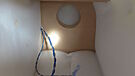
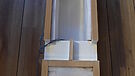
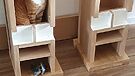
The search for the ideal location for the bass reflex port led the designer to side ports located directly behind the front panel, that is, as far forward as possible without radiating forward. At the bottom of the loudspeaker cabinet is a 9 x 4 cm opening on both sides, shielded on the inside of the cabinet by a shelf, so open only at the top (see photo). Through simulations and especially a lot of listening, this construction and size came about.
The art of damping
Damping in a loudspeaker is intended to absorb the mid-frequencies radiated from the back of the cone. Damping is essential for good sound because the mid-frequencies radiated to the rear cause standing waves, flutter echoes and internal reflections. The standing wave causes resonances; internal reflections leak out through the cone and come back delayed. This gives coloration to the soundstage, and flutter causes annoying reverberation.
Why only the midrange? bass-frequencies have long wavelengths (e.g. 100 Hz ≈ 3.4 m), these do not fit in a loudspeaker cabinet, therefore do not cause standing waves, and damping material is far too thin for such a long wave, it has no grip on it. High frequencies are strongly directional and are quickly absorbed by the cone material, coil and basket, damping is simply not necessary.
A standing wave originates between two walls, is a combination of an outward and a return wave, and is nothing but a wave that does not move.
A flutter echo is a high-frequency disturbance, it also occurs between two walls. Just clap your hands in an alley with high walls and you can hear approximately what this sounds like.
Simply filling the enclosure with damping material is not recommended, an over-damped speaker sounds lifeless and sluggish. Sound attenuation is really complex, but in short it works effectively when the wave has high velocity and when there is high pressure. In the middle of the cabinet you have velocity but no pressure, and at the walls you have a lot of pressure but low velocity. That’s why you usually attenuate at the walls with cotton wool with a solid structure, and because the waves have to squeeze through the material, a high velocity is artificially created that way.
In this design, the side walls and back walls are lined with Bondum 800. This way you can suppress flutter echoes and standing waves well, but not the standing wave in the longitudinal direction of the cabinet which usually occurs around 200 Hertz. Absorbing this would require so much wadding that the speaker would be completely damped.
This standing wave can be better absorbed with an internal Helmholtz absorber (a hobby hi-fi development, HOBBY HiFi 1/2011). This is an extra chamber at the bottom of the speaker cabinet with fairly heavy damping made of 4 layers of 60-gram polyester and with a circular opening to the speaker cabinet (see photo). At the top of the cabinet behind the tweeter are also 6 layers of 60-gram polyester. Again, the design is theoretical and optimized by a lot of listening.