



Intro
Contents
In the last century it was still very common to build your own speakers, the reason was obvious: for roughly half the price you could build speakers with the same sound quality as a pair from the store. After all, there was no money put in labor, marketing and margins for the distributor and store. Does that still count today?
In the heyday, there were multiple vendors. Usually you bought a kit with proven quality. You could then choose whether to solder the crossover yourself or glue the cabinets together. Nowadays, however, it is much less common, the main reasons being that the major brands already put very good speakers on the market for an entry-level price. And not insignificantly, that they can offer a nicer finish. That level of finish is simply hard to match as an DIY’er!
From Seas Excel to Exotic
Your author owns a pair of homebrew speakers with Seas Excel drivers, they date back to the year 2000, purchased then for 1000 Euros for a pair. Several years ago I put in a better tweeter, upgraded the crossover (in consultation and together with Speakerland from Oss, Netherlands) with high-quality components (especially in the circuit for the bass), internal cabling and the connectors.
Man! What an ear opener that was! The quality of the basic components determines so much! You can only find these kinds of components in the more expensive models from mainstream vendors. For the models lower in the range, a lot of time and effort can still be put into development, but in production and sales, margins have to be considered and then cheaper components are quickly chosen. And that is audible!
If you want to know more about this, I recommend watching a YouTube video by Danny from GR-research, he takes existing speakers apart and shows where you can improve them by using better components. This is a service that you can also get from several speaker builders by the way.
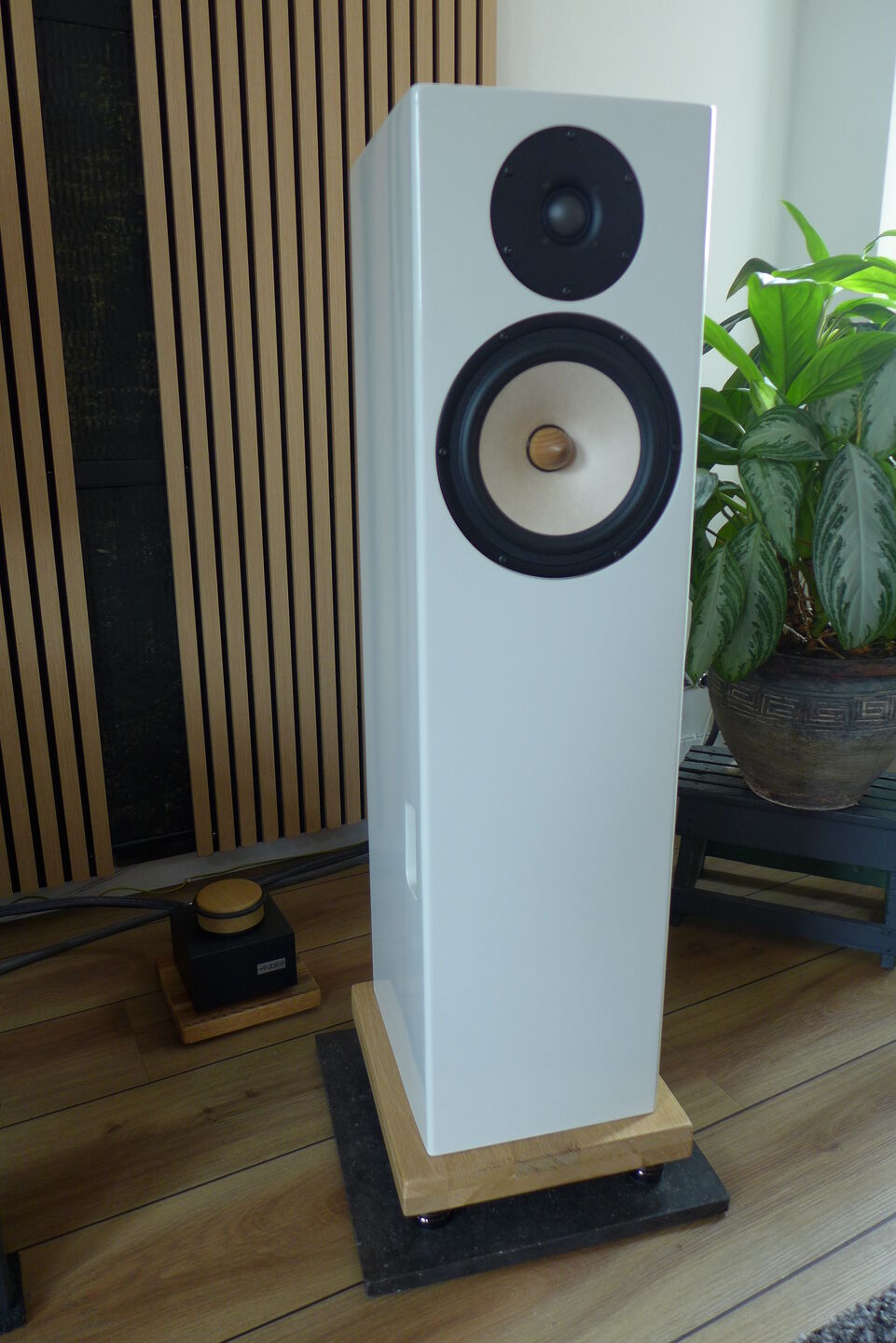
I have upgraded my hifi system quite a bit over the last few years and felt that now it was my speakers’ turn. However, I ran into the problem of having to dig very deep into my pockets to top the homebrew pair. So I started a search for a nice diy-design and found a design by Bernd Timmermans (Ing buro Timmermans, Kleve), published in the German magazine Hobby Hifi in 2012. It is the Exotic Tower, a two-way bass reflex model with drivers from Seas Exotic.
Exotic is the top line from Seas and contrary to what the name suggests, it does not use exotic materials such as kevlar, beryllium or diamond. On the contrary, they are based on legendary drivers from the sixties/seventies: the Saba greencones woofer and the Audax HD13D34H dome tweeter, which were widely used in BBC studio monitors.
This is a paper bass/mid woofer and a 35 mm textile dome tweeter that they have tried to perfect in every way. The Exotic W8 is an 8-inch driver with a paper cone embedded with papyrus fibers for optimum rigidity and low weight. A special foam surround reduces mass by 40% compared to conventional rubber surrounds, resulting in high sensitivity and better damping characteristics. The spider has an open weave combined with a new resin formula, the weave is acoustically transparent which minimizes reflections and resonances. A hand-made ash phase plug provides optimum rejection for critical mid frequencies. A rigid and stable injection-molded zinc frame with ample openings should minimize sound reflection, airflow and cavity resonances.
The Exotic T35 is a classic fine textile dome midrange tweeter. The dome was manufactured by Dr. K. Müller in Germany, one of the first in the world to produce textile domes and who has continued to perfect the technique over the years. The 35 mm voice coil is wound from copper-clad aluminum wire on a rigid non-conductive fiberglass polymer film, which benefits sensitivity. Flexible spout wires and ventilation holes in the aluminum spool holder help minimize noise.
Both drivers are equipped with an alnico (aluminum-nickel-cobalt) magnet. These are expensive, but are very stable and have high magnetic flux density, which means that speakers get a fast response and they take up little space which in turn is advantageous because they minimally disturb backward-radiating waves. Nowadays stronger magnets are available such as neodymium, but alnico exhibits a subtle magnetic saturation at higher loads, this provides a gentle natural dynamic compression, resulting in the smooth character they are known for.
The crossover
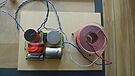
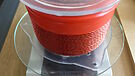
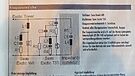
The design uses a first order crossover built with high quality components, including a Tritec air coil (wound with 7 strands of pure copper wires insulated from each other in resin so that the windings of the coil cannot resonate, this coil alone weighs 2.5 kg and costs 250 eu. I was impressed when I received it though! Furthermore, there are Audyn Cap reference capacitors in it.
Some components were so exotic that I had to wait a while for them; the manufacturer does not have them on the shelf and they are only made to order. A first-order filter is highly exceptional because often the characteristics of the woofer and tweeter do not run together nicely and this will lead to an irregular frequency response in the transition region. Fortunately, Seas’ drivers are exotically matched and have an even frequency range roll-off that does make this possible.
The advantages of a first-order filter are: minimal phase problems, good preservation of time behavior and relatively simple design. Basically, all you need is a coil for the woofer and a capacitor for the tweeter. With this crossover, absorption circuits are placed in addition to these two components to get the filter slope as flat as possible. The filter is placed in a separate space at the bottom of the cabinet to prevent it from being exposed to vibration, and to further improve this, you could fill this space with dried quartz sand. This has the added advantage that the temperature of the filter remains constant and there is about 10 kg of extra weight at the bottom of the cabinet which stabilizes the speaker.
I was hesitant to do this, I was afraid of moisture, which did not seem conducive to the expensive components in the cross over. If you may believe the experts it should be possible and it gives just another small improvement. This tweak I applied after long hesitation, see the findings in the listening section.